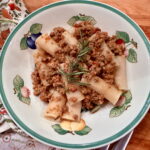
White Bolognese (Bianco Ragu)
The original Bolognese Sauce is from the Emilia-Romagna region of Northern Italy and is prepared without tomatoes. It's an old recipe created before tomatoes were brought to Italy. Thick and rich, it's slow-cooked with a pancetta base along with cream, milk, and Parmigiano Reggiano cheese. It's seasoned perfectly with rosemary, sage, thyme, and organo, and nutmeg.
Servings: 14 servings
Calories: 585kcal
Equipment
- 1 ground meat chopper
- 1 mini food processor
- several sharp cooking knives
- mixing bowls in a variety of sizes
- a wooden cutting board
- 1 large, deep pot or Dutch Oven
Ingredients
For the Soffritto
- 1 cup minced onion or shallots
- 1 cup minced carrots
- 1 cup minced celery + leaves
For the Remaining Bolognese Ingredients
- 1/4 cup extra virgin olive oil
- 5 cloves garlic, minced
- 1 cup diced pancetta (or guanciale)
- 1 lb. ground chuck
- 1 lb. ground pork
- 1 lb. ground veal
- 1 lb. mild Italian sausage, meat removed from casings
- 1 large Parmigiano cheese rind
- 1 cup heavy cream
- 1 cup whole milk
- 1/2 cup dry white wine
- 4 - 6 cups chicken broth
- 1 cup freshly-grated Parmigiano cheese
- 1 Tbsp. fresh rosemary, minced
- 1 Tbsp. fresh oregano, minced
- 1 Tbsp. fresh sage, minced
- 1 Tbsp. fresh thyme, minced
- ½ tsp. ground nutmeg
Instructions
Prepare the Soffritto!
- Heat olive oil in a large pan/pot on low-to-medium heat.
- Add the onions, carrots, celery (and leaves) to the oil. Saute' until tender and somewhat translucent, and aromatic . . . for about 5 minutes
- Although not part of a soffritto, for this recipe, add the minced garlic to the soffritto and saute' for another 3 minutes. Adding garlic at the end helps prevent it from burning.
- When finished sauteeing, remove all of this from the pan and set it aside to use later on in the recipe.
For the Bolognese ragu:
- Add the pancetta to a medium-hot pan (it's ok to use the same pot/pan) and cooki until it is a reddish-brown color (about 10 minues), being careful not to burn the pancetta. It is fine to substitute guanciale or thick bacon.
- When pancetta (or guanciale) is finished cooking, add all of the meats to the pan and begin to saute on low to medium heat. Break up all of the clumps of meat into a 'minced', ground meat texture. Mix the meats together thoroughly. For about 15 minutes, stir occasionally, and continue to break down any clumps.
- At this time, I add seasonings that I believe enhance any recipe: Accent, Nature's Seasons, and Mrs. Dash Original Flavor Seasons. I sprinkle a good amout all over the meats.
- When the meats are a nice brown color, add the soffritto (plus garlic) back into the cooked meats and mix everything thoroughly.
- Add the herbs and the ground nutmeg, the lemon peel, and the Parmigiano rind.
- Add the dry white wine and stir until well absorbed.
- Add chicken broth one or two cups at a time, stir and allow it to be well-absorbed before adding the next round of chicken broth. Always add broth first and allow to fully absorbed after every addition of broth.
- Add the cream and milk.
- Add the freshly-grated Parmigiano cheese. You can add more later if you prefer.
- Set the heat on low and simmer the Bolognese ragu for 2 - 3 hours, preferably 3 hours. Keep your eyes on it and stir occassionally so that the sauce does not burn. Also use a spoon to skim off any grease/fat that rises to the surface of the ragu while cooking; this will happen more near the end of cooking.
- Add salt and pepper to taste. Add any more ingredients you feel you prefer, such as more Parmigiano cheese, more herbs and/or nutmget, more cream, more broth, etc.
- Serve with wide, large pasta noodles that have been cooked al dente. Add pasta water to the sauce to achieve a more silky desired consistency. Serve on top of the pasta, or serve thoroughly 'mixed into' the pasta with extra sauce served and passed around to guests who want more sauce.
Video
Notes
- Dry white wine options that work well in this Bolognese are:
- Pinot Grigio
- Pinot Gris
- Sauvignon Blanc
- Soave
- Yes, you can serve this Bolognese with any pasta that you prefer, and always use what you enjoy the most. However, due to the heavy nature of this ragu', here are some recommendations for you that I've been taught to use:
- Paccheri (hands-down my favorite pasta shape EVER) - huge, wide noodles with a great big hole or tube that the ragu fills, so you get a lot of sauce with every huge noodle! So awesome!
- Rigatoni - The same results, with a slightly smaller pasta shape, and easier to find in a local store.
- Pappardelle - nice wide 'long' noodles that the ragu sticks to nicely.
- Tagliatelle - not as wide as pappardelle, but the ragu hugs the pasta nicely too.
- I've also made this with gnocchi, and it works quite well with these pillowy soft dumplings!
- White bolognese is easy to freeze without any pasta.
- When reheating, add more cream or broth if it feels too dry.
- Add some pasta water from the pot your pasta was cooked in so the sauce clings better to the pasta and achieves a more silky, glossy texture.
- Always good White Bolognese on a gentle, slow simmer.
Nutrition
Serving: 1cup | Calories: 585kcal | Carbohydrates: 8g | Protein: 35g | Fat: 43g | Fiber: 1.5g | Sugar: 3g