
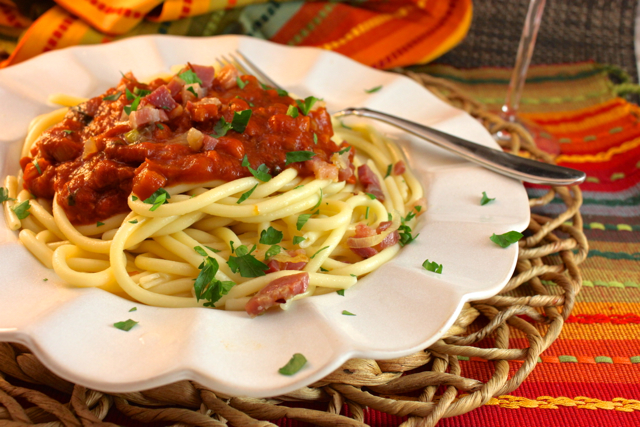
Bucatini all’Amatriciana
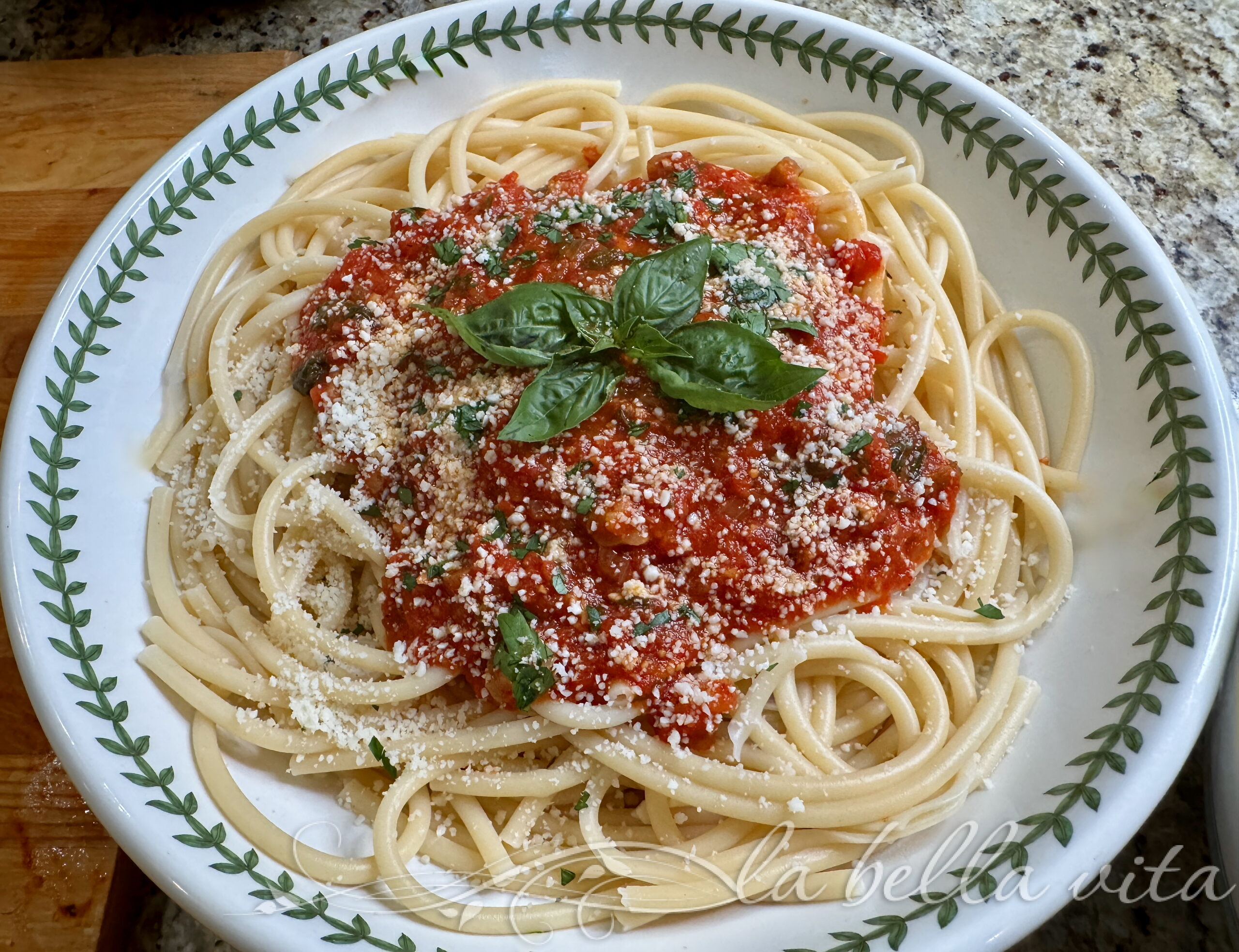
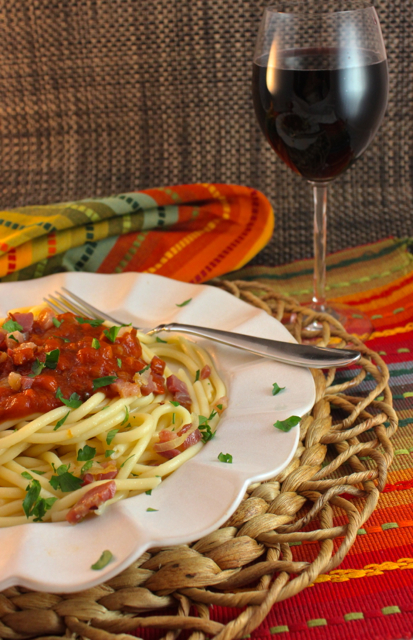
This classic pasta recipe has been posted and shared several times: when I first posted it in 2013, and again after the earthquake that struck Amatrice, Italy. At that time, I joined restaurants and food bloggers around the world who also prepared this classic Bucatini all’Amatriciana recipe as a tribute to the victims.
I posted this classic Roman pasta recipe again several years later, when my cousins from Modena, Italy, visited me and prepared it for us. The village of Amatriciana’s famous pasta recipe is prepared quite often in my family, both here in the States and in Italy.
So before I get to the reposted recipe and photos, I want to share a step-by-step guide to preparing Bucatini all’Amatriciana by my two cousins from Modena, Italy, who visited us in July. It was just as delicious as it possibly could be, prepared with ingredients that their parents had shipped from Italy!
The complete recipe is at the bottom of this post for you to print.
You can also view my video to help guide you:
So, my friends, I present to you my cousins, Francesco Santi and Filippo Gualdi, in my cucina:
Andiamo a cucina! (Let’s go to the kitchen)!
STEP ONE
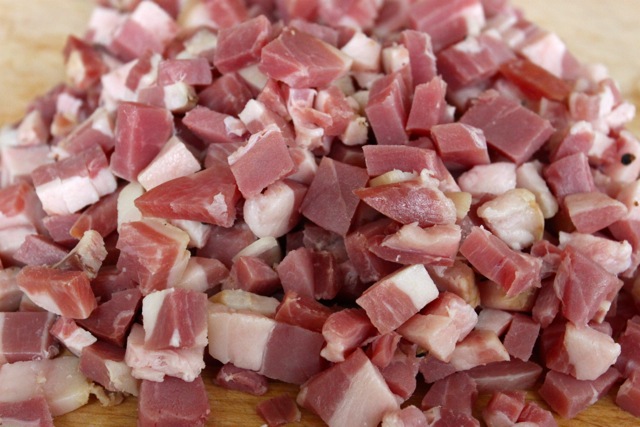
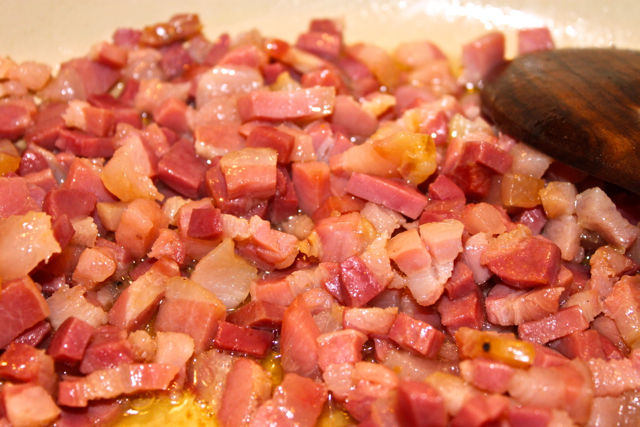
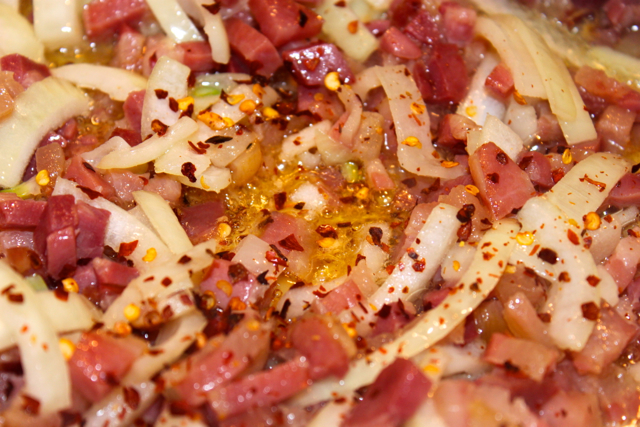
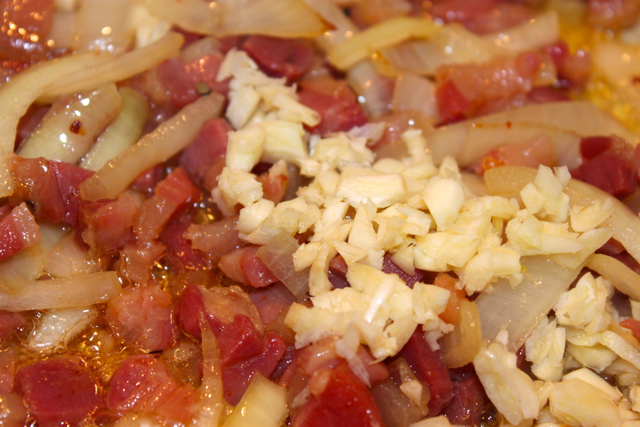
After dicing the pancetta or guanciale, sauté the meat in olive oil over medium heat in a heavy skillet. Here is Francesco beginning the dish. Add the onions, garlic, and hot red pepper flakes (or 1 dried pepperoncino). Sauté until browned, about 10 minutes.
NOTE: It is preferable to use “guanciale,” the ‘cheek of the pig’ as is used in Italy for Bucatini all’Amatriciana, but it is very difficult to find in the States other than large cities — here’s the link to purchase online: Guanciale),
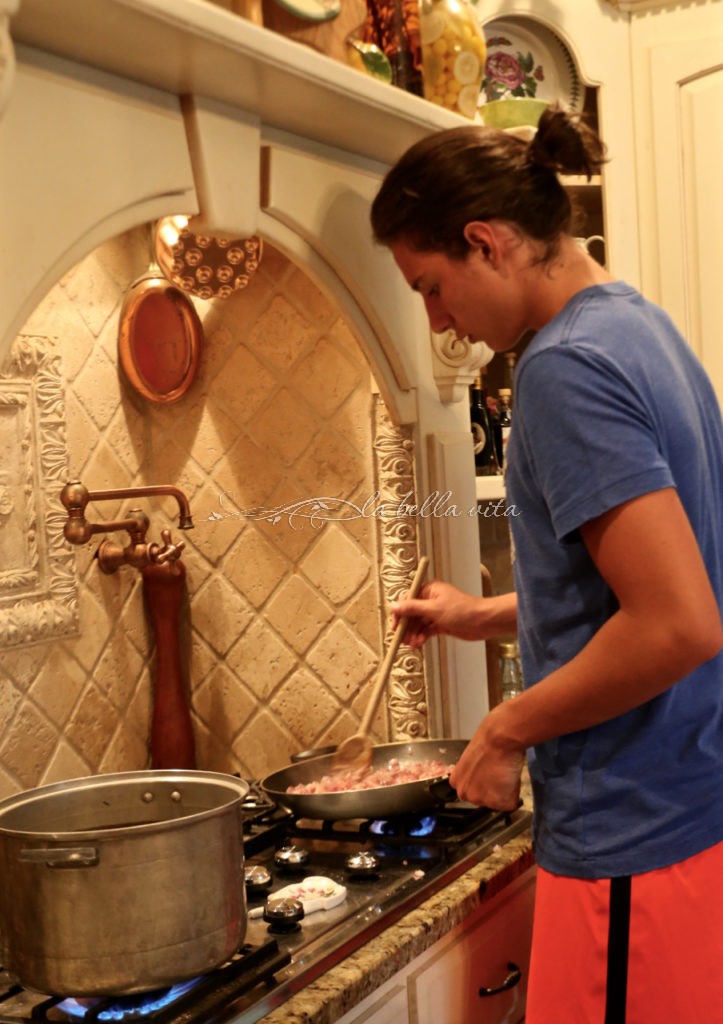
Sauté the diced pancetta or guanciale (cheek of the pig) — add the onion, garlic, and peperoncini. Sauté per instructions.
STEP TWO
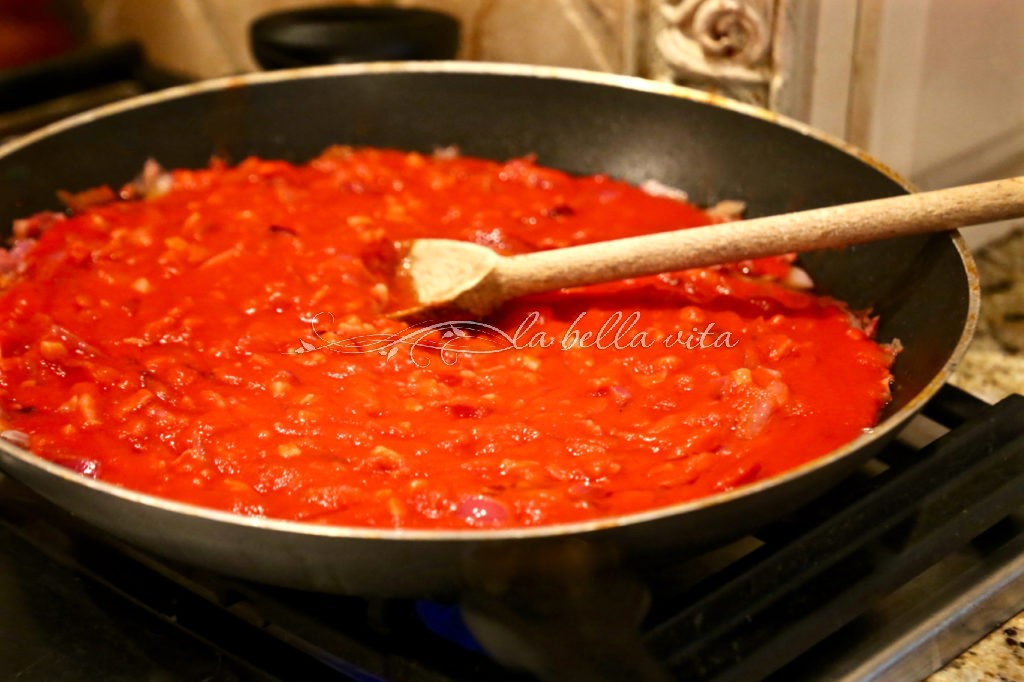
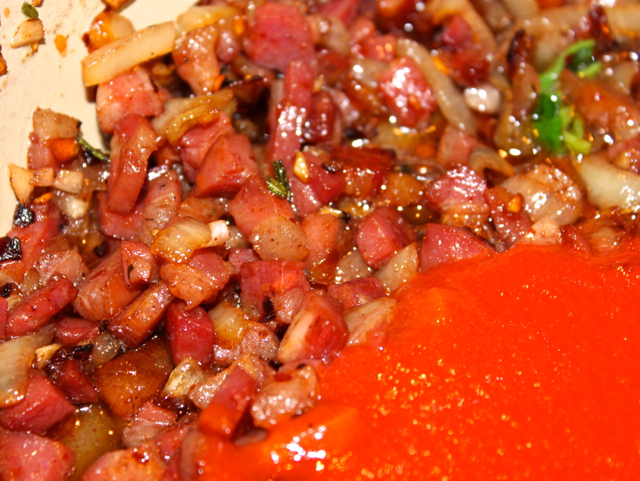
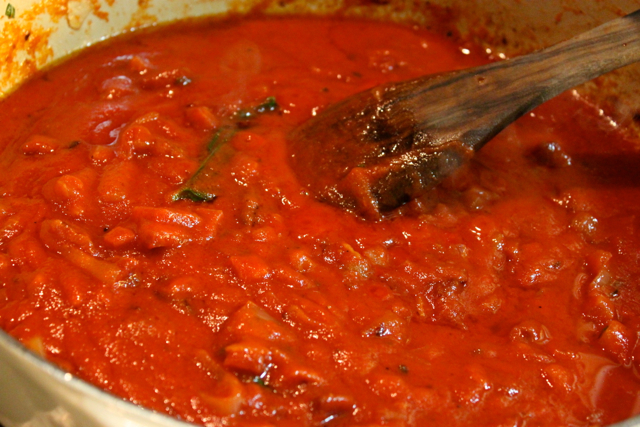
Add freshly chopped tomatoes OR use imported Italian San Marzano tomato ‘passata‘ from the “Mutti” brand. This is what my family in Italy uses and here’s the link to purchase it online: MUTTI, because you won’t find it in any American stores. My family does not add wine to our sauces, but it is entirely up to you to add wine at this point. Gently stir the mixture until nicely blended. Bring to a simmer, reduce the heat to low, and cook at a gentle simmer for about 20 minutes, until the sauce is thickened.
STEP THREE
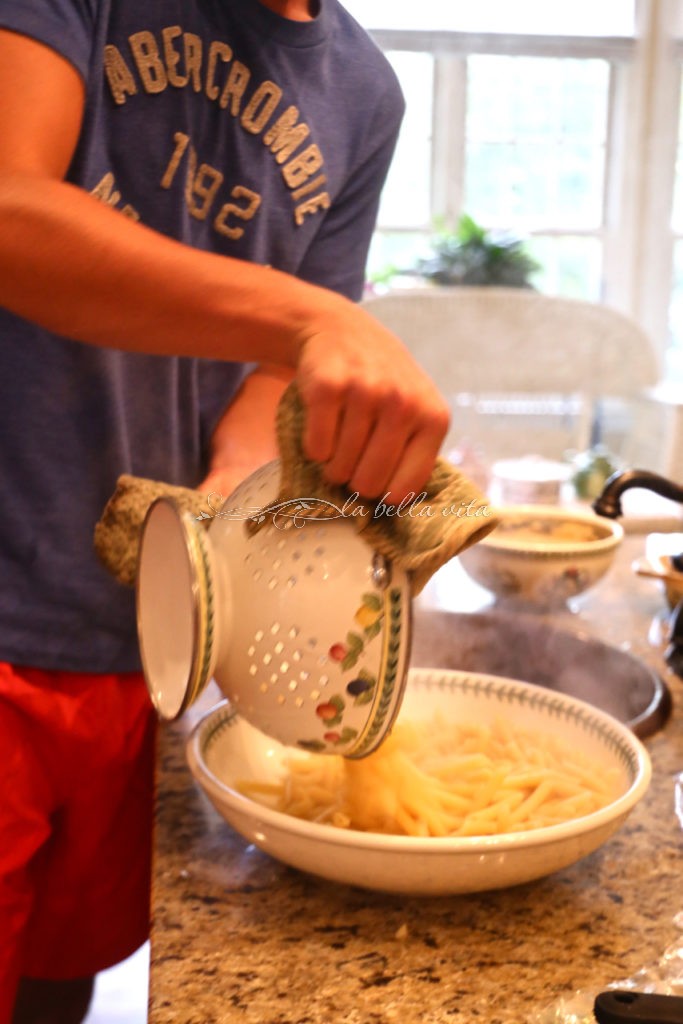
In boiling, salted water, cook your pasta for no more than 5 minutes until al dente and strain the water, leaving 1/2 cup of pasta water to add to the sauce. Pour the strained pasta into a large, shallow, and wide pasta bowl as Francesco is doing below. Here we are using the pasta (penne shape) that my cousins shipped to us from Italy. You can use any hefty shape of pasta that you prefer, but it is traditionally served with the famous bucatini pasta shape with the hollowed out center as you can see in the photos at the top and bottom of this post. The sauce is too robust and heavy for delicate pasta shapes. Here is the link to purchase Bucatini pasta online: bucatini
STEP FOUR
Add about a handful of freshly grated pecorino cheese to the simmering sauce on the stove and blend well. Then carefully pour the hot Amatriciana sauce onto the hot pasta.
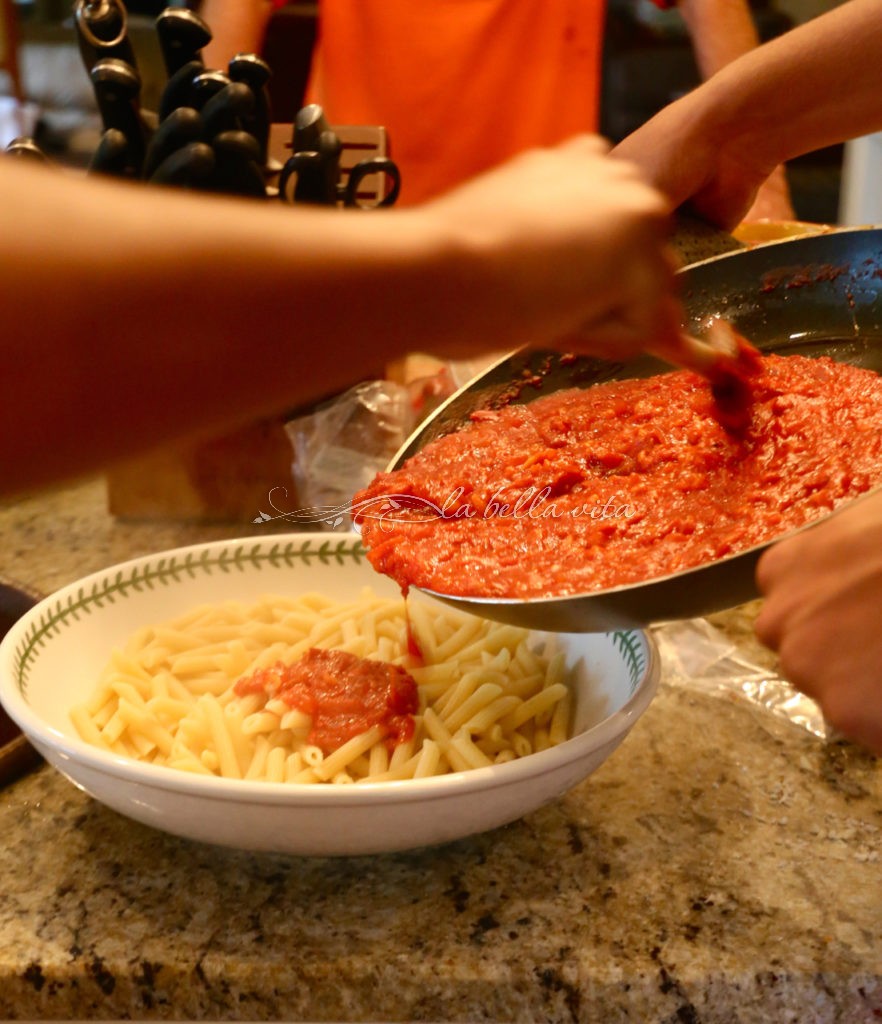
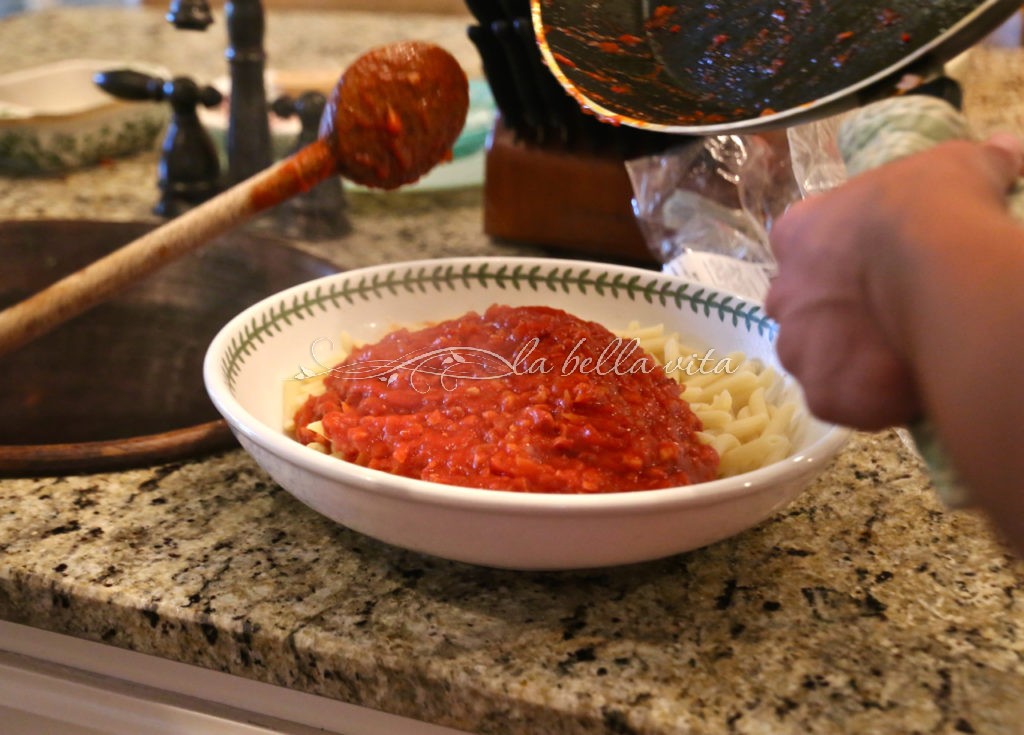
My family (both in Italy and the States) prefers a lot of sauce, so we pour it all into the pasta. We also have another bowl of sauce on the side to pass around the table.
STEP FIVE
Gently and thoroughly stir the sauce with the pasta. Add the reserved pasta water a little at a time to loosen the sauce to your desired consistency. Taste. Add more cheese if you like. Make sure you have plenty of grated pecorino cheese to take to the table as well.
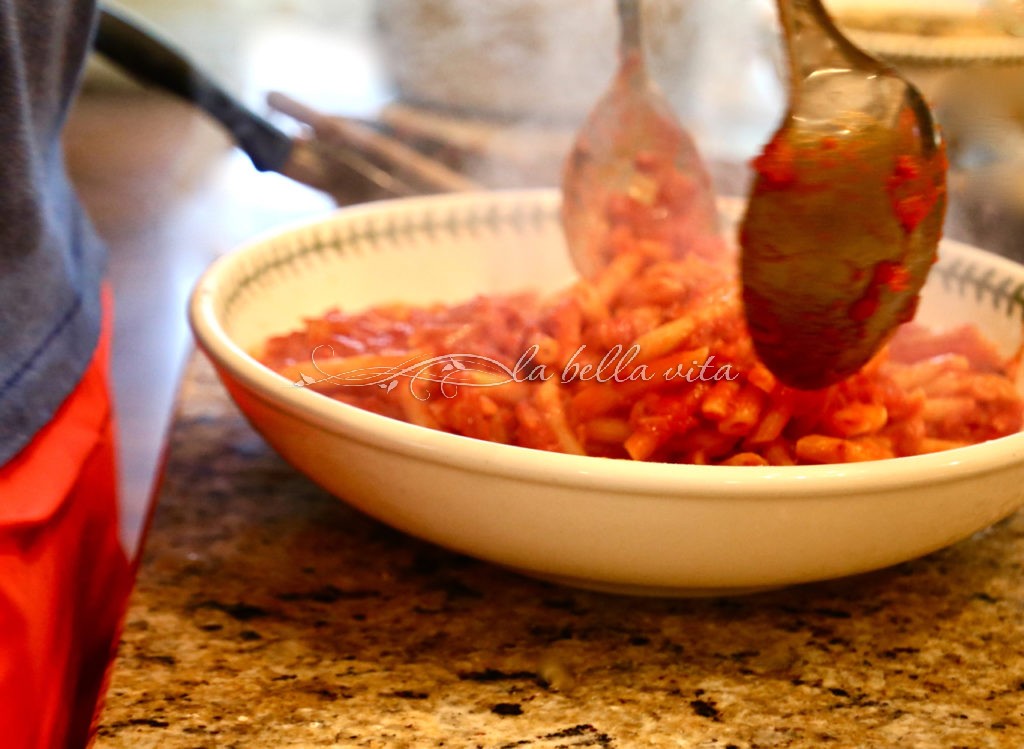
FINALE
Serve your Bucatini all’Amatriciana at your tavola (table) with amore (love), and enjoy as your guests devour this delicious pasta dish!
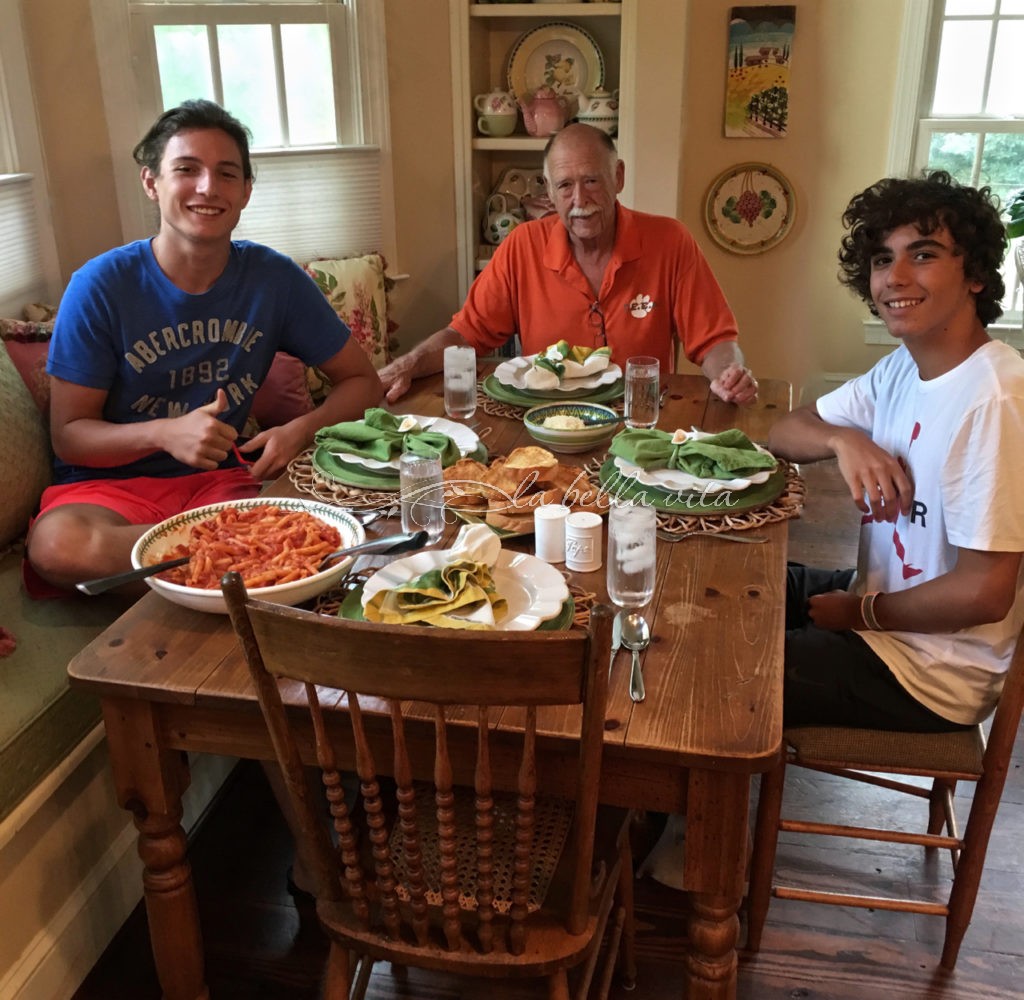
Francesco (on the left), my husband Bill, Mr. Meat and Potatoes (center, who can’t get enough pasta), and Filippo (on the right). Notice that Italians in Europe do not use ice in their cold beverages as we do here in the States. Filippo and Francesco were typical in this setting without ice in their water, as did Bill and I.
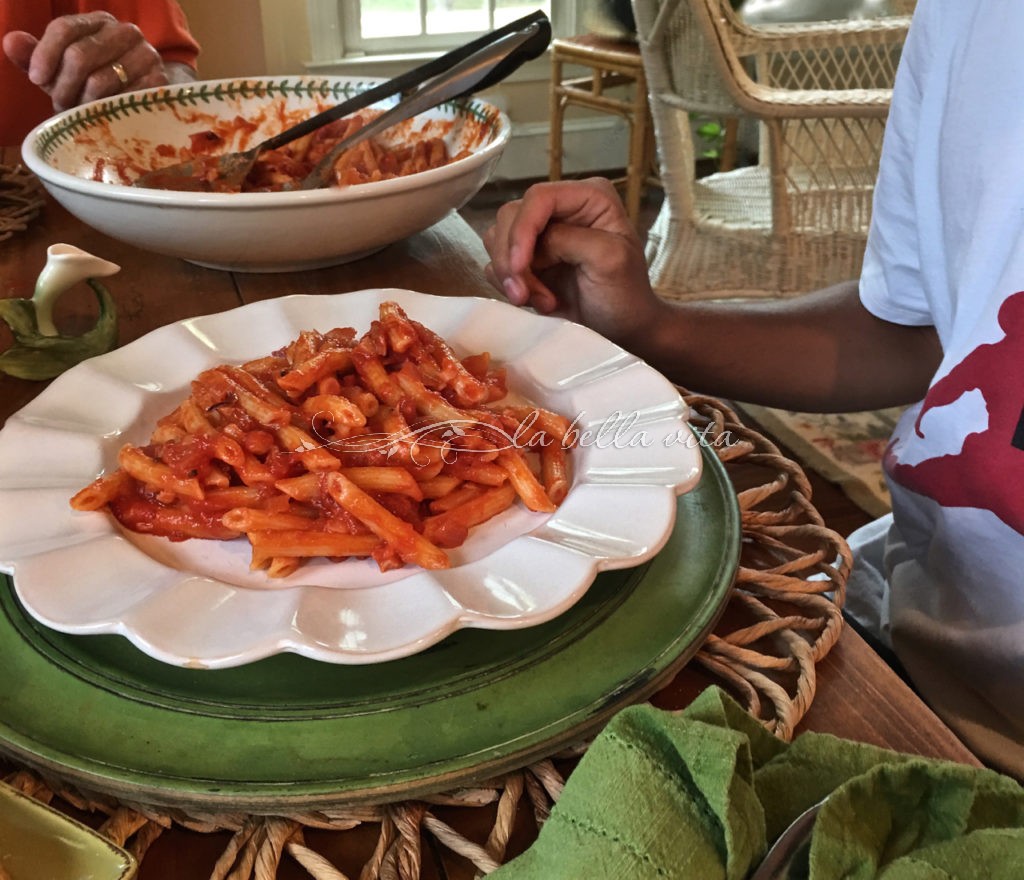
Again, my family loves a LOT of sauce as well as large portions, proven by Filippo’s first portion shown below; he had a second portion of the same size! Now that’s a lot of pasta! I’d love to be able to eat that much pasta!
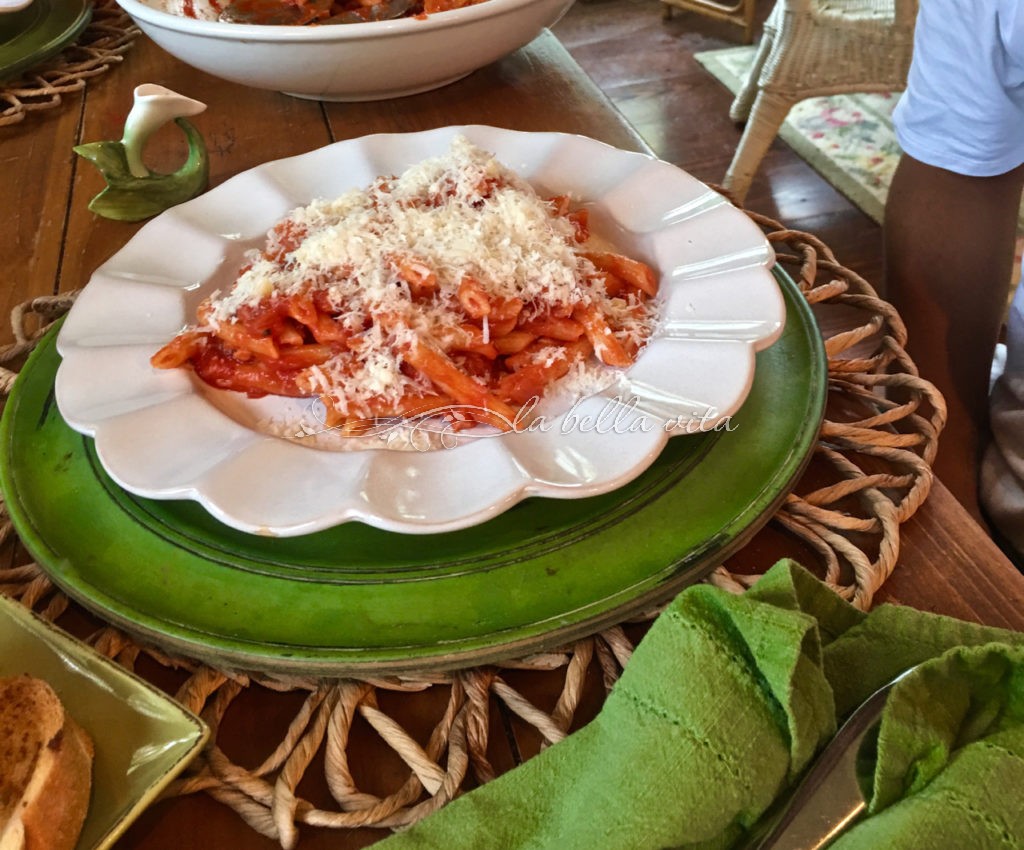
Sprinkle freshly grated pecorino cheese on top. A little sprinkle or a lot . . . in our family, we live by the saying, “You can never have enough cheese.” This cheese was also shipped to us from my cousins, so we had extremely delicious cheese on this pasta! Filippo likes a lot of cheese too; after all, he’s a 14-year-old athlete and a growing young man!
What a blessing we were given to have two teenage boys from Italy who wanted to spend a few weeks with us here in the States and even cooked for us! And doubly blessed to have their parents want them to experience ‘real life’ in the States and not just as tourists in New York City, Boston, and Miami, which they have already visited. I can’t wait to visit them again next summer and to learn to cook more delicious pasta recipes!
.
A classic Italian sauce, “Amatriciana” is named after the mountainous town in the province of Lazio: Amatrice, Italy.
This sauce in “Bucatini all’Amatriciana” is pure simplicity with an intense flavor all blended together, yet gets its robust gusto from only a handful of ingredients. Numerous interpretations of this recipe abound, but every version always includes perfectly red, sun-ripened Italian tomatoes, pancetta or guanciale, onions, garlic, and a sprinkle of fiery hot pepperoncini (hot red pepper flakes). Amatriciana sauce is traditionally served with bucatini, a type of pasta similar to spaghetti, but with a long, hollow tube running through the entire noodle.
Purists will only use guanciale that, until recently, has been difficult to locate in the States (just click on the word in ‘blue’ and the link will take you to where it can be purcahsed). It’s pricey stuff, but you can freeze what you don’t use for later.
The reason for the preference for guanciale (which originated in the Roman Lazio region of Italy) is that it is a cut of pork with significantly more marbling and fat, therefore imparting a richer, more intense meaty flavor than pancetta or bacon. But good pancetta makes a nice substitute.
When preparing this sauce, make sure that you use the best imported San Marzano Italian tomatoes that you can find and high-quality pancetta or guanciale, each of which is like bacon on crack!
This is not exactly a heart-healthy recipe. But if you’re like my family and believe that pork rules, then you’ll be just fine with some fat every now and then. Eat your cabbage soup the day after you splurge on this pasta!
My husband and I prefer recipes a bit more ‘amped up’, yet perfectly balanced, so I’ve added my usual embellishments that accomplish extra flavor very nicely.
Although this is a typical dish found in Roman homes, ristoranti and trattorie, it was in Northern Italy where we first enjoyed Bucatini all’Amatriciana. For our last dinner at my family’s home in Modena, my cousin Silvia (who works full-time outside the home) insisted that we stay for one more meal. Since she works, we felt that this was too much for her. But Silvia insisted and said that the pasta she was preparing was neither difficult nor time-consuming: “Not to worry, stay for dinner before you get on the road and drive to Florence.”
A huge, gigantic platter of Bucatini all’Amatriciana with penne was graciously presented to us to enjoy. We devoured the pasta in a perfectly spiced sauce studded with bits of guanciale. We loved it and asked Silvia about the recipe. My mother and I simply could not get over the flavor that resulted from such a simple combination of ingredients! Nor could we get over how quickly she had dinner ready on the table for us!
Delicious, easy, and fast enough to pull off in less than an hour! Works for me!
I always keep canned Italian tomatoes from my garden in my pantry, as well as pasta, so all I have to do is get the pancetta/guanciale and pick the fresh herbs from my garden right outside my kitchen. I always buy a little more pancetta/guanciale to freeze (as I do with almost every food item that freezes) because we live so far out of town on the acreage. By doing this, we keep our freezers constantly stocked, so all I have to do is just pull something out when I need it after work.
For my version, I added rosemary, sage, basil, and Italian parsley . . . simply because my herb garden is ripe and ready to use. I was also given a nice bottle of red wine by a student in one of my classes, whose Italian father produces a delicious family wine to pair with this pasta.
Totally irresistible and seductive!
.
Recently, I was invited by Tuscany Now to participate in an Italian Cooking Competition to create and submit an Italian recipe that combined authenticity and creativity for their second annual Italian Cook-Off. This recipe, Bucatini all’Amatriciana, (since it is so special to my family both here in the States and in Italy) was my top choice of all my recipes to enter into the contest.
It was an honor to be selected among the 1,000’s of global food blogs. Grazie mille!
.
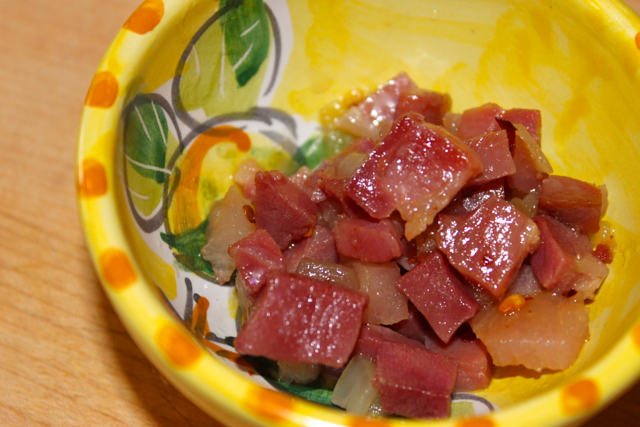
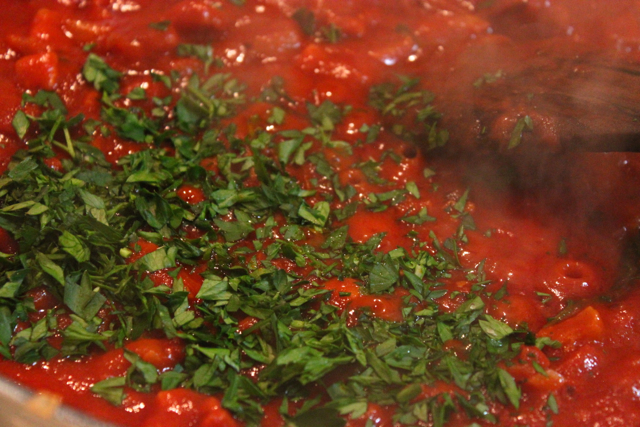
Finally, add the chopped rosemary, the sage and basil leaves, and the chopped Italian parsley to give the sauce a delicious layer of additional flavor and a lovely green accent and additional flavor! These are our additions to the classic recipe and very much enjoy their addition. My husband says that this sauce is truly “MAREVELOUS!”
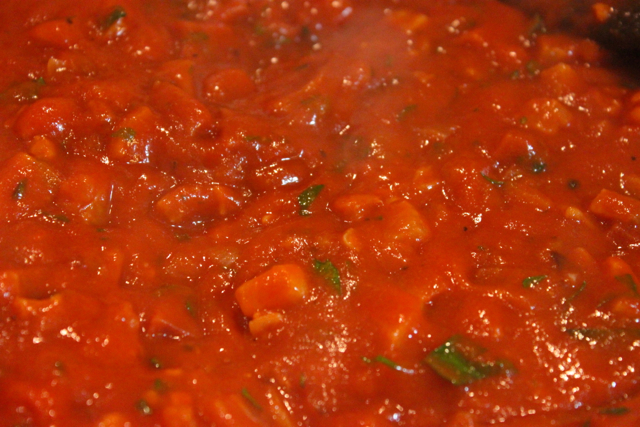
Simmer on the stove for about 20 minutes. The sauce should be THICK, not runny, thin, or liquidy. When you strain the pasta, pour about a half cup of the pasta water into the sauce (if desired). There will also be a little bit of water in the tubular pasta. This adds flavor and a little more thickener for the sauce.
Enjoy! This is a very hearty, filling pasta that I hope you will try!
Sprinkle a little more chopped Italian parsley over the pasta and sauce.
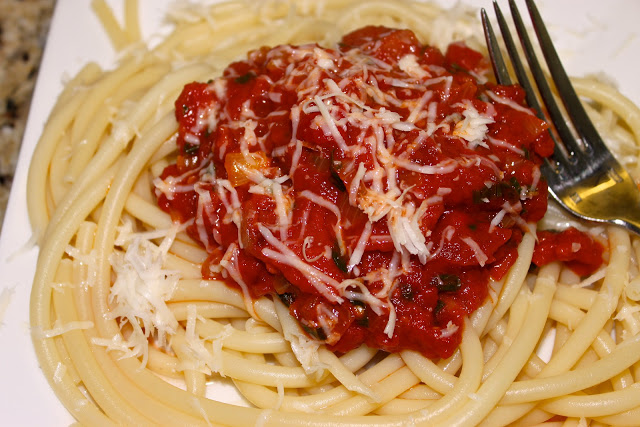
Pass the Pecorino-Romano cheese around to your guests.
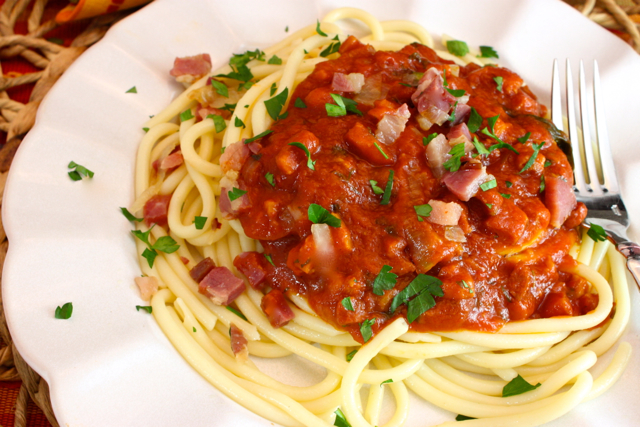
Below is another recipe using the bucatini pasta noodle with a red pepper sauce that is especially great for those who prefer to eat less or no meat in their diet:
Bucatini with Roasted Sweet Red Pepper Sauce
disc.
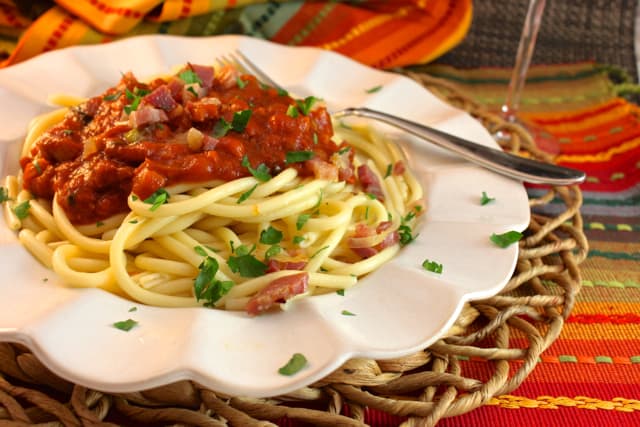
Bucatini all' Amatriciana
Ingredients
- 2 Tablespoons extra-virgin olive oil
- 12 ounces pancetta OR
- guanciale
- 1 medium onion, minced
- 5 cloves garlic, minced
- 1/4 teaspoon pepperoncini (dried red pepper flakes)
- 2 Tablespoons red wine
- 28 oz. San Marzano pureed or Mutti 'passata' sauce
- pinch sea salt, freshly grated
- pinch black pepper, freshly grated
- 2 teaspoons sugar or ½ cup shredded carrot
- 2 large basil leaves, torn and julienned
- 1 large sage leaf, minced
- 1 sprig rosemary, leaves only, minced
- 1/4 cup Italian parsley, minced
- 1/2 cup Pecorino Romano cheese, freshly grated
- 1 lb. Bucatini pasta
- 1/2 cup pasta cooking water
Equipment
- 1 heavy 12" frying pan non-stick is best
- 1 large mixing spoon cilicone tools are best with non-stick pans, but wooden spoons will also work nicely on any pan surface
- 1 cook's knife
- 1 mixing bowl
- 1 wooden cutting board
- 1 tall/large pot
- 1 strainer
Instructions
- Saute’ the After dicing the guanciale (or pancetta) in olive oil on medium heat in a heavy skillet for about 6 - 9 minutes until 'reddish-brown' in color.
- Add the onions and saute' until browned for another 4 - 5 minutes.
- After these are browned, add the garlic and saute' for another minute or two.
- Add freshly chopped tomatoes OR imported Italian San Marzano tomatoesfrom the MUTTI or San Marzano brand.
- It is entirely up to you to add wine at this point (about 2 Tbsp. of either red or white wine).
- Add the rosemary. Then mix in the sage and basil leaves. Then add the Italian parsley (these are my additions and totally optional)
- Gently stir the mixture until nicely blended together.
- Add one cup of freshly grated Pecorino Romano cheese to the sauce and blend well. Lower the heat down to a simmer.
- Bring the sauce to a simmer, reduce the heat to low, and cook at a gentle simmer for about 20 minutes, until the sauce thickened.
- In a large/tall pot, fill with water, adding a handful or 2 Tbsp. of slat) and bring to a boil. Add the pasta and separate with a mixing spoon. Cook your pasta for no more than 7 minutes until al dente and strain the water, leaving 1/2 cup of pasta water or so to add to the sauce (if desired).
- Using a strainer, carefully remove the pasta into a large, shallow, and wide pasta bowl (see this on the video). You can use any shape of pasta that you prefer, such as spaghetti, but this sauce is traditionally served with bucatini.
- Carefully pour the hot Amatriciana sauce onto the hot pasta. Gently and thoroughly stir the sauce with the pasta.
- Add the reserved pasta water a little at a time to create the sauce to your desired consistency. Taste. Add more cheese if you like. Make sure you have a lot of grated Pecorino Romanao cheese to take to the table also.
- Garnish with fresh basil leaves and sprinkling of Pecorino Romano all over the top of the pasta and sauce.
Notes


Looks delicious Roz. My mom made pasta sauce using bacon and I can imagine this being similar.
Oh yes, Larry, similar, but guanciale has a stronger fat level and different flavor. Pancetta is also used as a substitute like bacon is used.
Ciao,
Roz
How wonderful that you along with many others are showing your support to the victims of the earthquake in Amatrice, Roz! It is such a sad thing to have happened. My heart goes out to them. I followed along on Instagram when your cousins were here this summer . It looked like you all were having so much fun. What a treat to have them cook for you and such a delicious pasta dish! I hope all is well with you as you get back into the school year!
Congratulations on being selected for your recipe, Roz! I can totally see why you were selected. Wow! I kept saying that as I scrolled through your pictures. I love the things you added to increase the flavor. I haven’t cooked with pancetta very much, but would really like to try it. Thanks so much for sharing this family recipe! I am going to pin this to make soon.
Wow, I’m going to see if Whole Foods has pancetta to cut to size. When I’ve made this dish, I used the very thin pre-packaged variety. I’d love to try your recipe! Happy Thanksgiving week, Roz!
Thanks Liz! I can’t remember where I found the chopped up pancetta, but I’m sure Whole Foods has some! Thanksgiving was great . . . totally relaxed and refreshed (something that I get very little of). Hope your Christmas season is full of joy!
I adore this dish – and you amped it up so beautifully. We’re still in the “cool” so I’m looking for sweet pasta comfort!
Claudia,
I will be so happy for you when it’s time to go outside and enjoy some fresh air! You certainly deserve it after having snow in May this year!
Roz
Pingback: 20+ Italian Recipes Roundup for #HGEATS #LoveItaly Week | The Hungry Goddess
Hi Roz! My mouth is watering so much right now. I adore pastas with simple sauces, like yours, that are packed full of flavour. What a great recipe. Thanks for sharing and for being a part of the YBR this month.:)
You are so welcome Nancy! It’s a pleasure being a part of your monthly food get-together!
Roz
Lovely recipes. Lovely photos. Lovely blog. Thank you!
Thank you Julie for your LOVELY words! I wish I could find your blog or place to visit, but you didn’t leave a web address.
Be well,
Roz
Oh, sorry. I am new to blogs. I don’t have one myself though. I received your reply via my email. Thank you. :~)
Hi Julie,
Thank you for letting me know! I hope you continue to follow along and we’ll be able to chat back and forth through your comments since I can’t stop by any blog. Once again, thank you and wishing you a warm welcome!!!!
Roz
This looks so good, I just love this dish. it’s one of my faves. You did it up right. So nice to meet you. Happy we connected through g+.
So nice to meet you too Kim! I can’t wait to read your Lemon Recipe Round-Up…..I know that I’m going to nuts!
Roz
Now I’m thinking what I would put in a veggie version. I love simple pasta sauces 🙂
Rachel,
That sounds like an interesting idea. We enjoy meatless meals too! Thanks for stopping by!
Roz
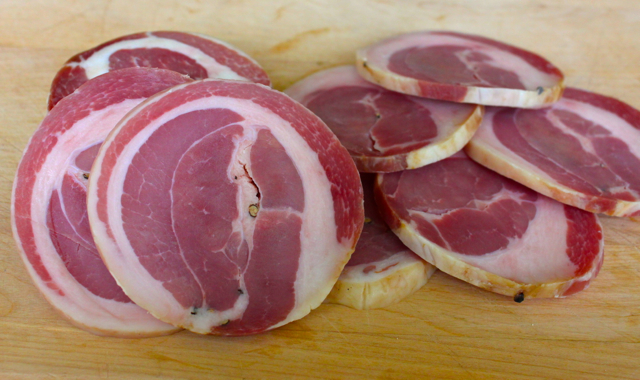
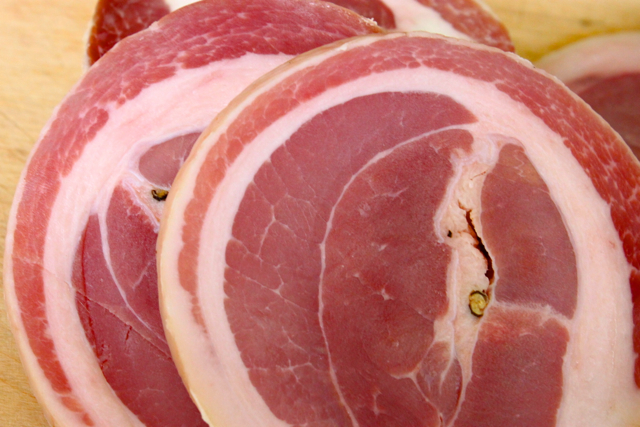
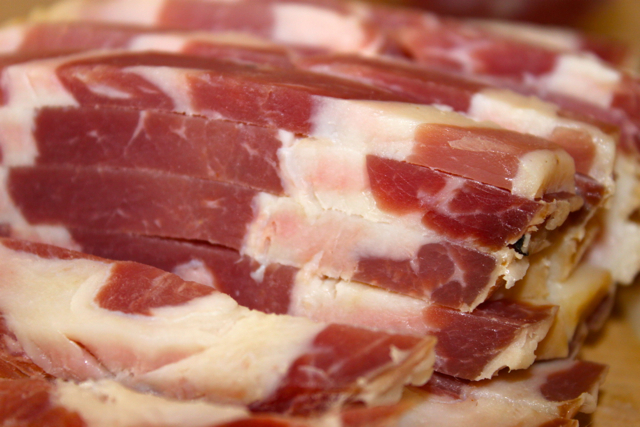
That is some beautiful pancetta! This pasta dish looks so delicious and fresh. I’m so looking forward to gardening season so I can splurge on pasta dishes again 🙂
Hi Susan,
Gardening season is here in the South and hopefully will be in your neck of the woods soon! I’ll stop by your spot now and see what you’ve been cooking up!
Roz
Love this super traditional take on this dish!
Thanks Joanne! Tradition is always a good thing when it is delicious!
Roz
Yes, that’s GORGEOUS pancetta. I have this pasta, just waiting for me to make this dish. You did a beautiful job, Roz.
Thanks Debby! Great ingredients certainly contribute to extraordinary results! Thanks for your comment!
Roz
Ciao Roz, perfect Italian receipt!! It is one of the faster pasta receipt, and you are right… it is very typical of Lazio. It is difficult to find this pasta in Florence, but obviously we prepare it at home, where you can pay attention to the products quality. The best tomatos you use, the tastiest pasta you obtain… 🙂
Your presentation is super, as usual.
Have a nice day.
Oh Ilaria, what an incredible compliment from an Italian who truly knows her culture’s delicious cuisine! Thanks for stopping by!
Baci, baci, baci,
Roz
Wow, that pancetta is fabulous! I’ve made this at home, but my son preferred the version he ate in Rome! I’ll have to try your recipe…I have come bucatini in my pantry 🙂 xo
Liz, everything tastes better in Italy . . . the best of any product is reserved to stay in Italy and not exported anywhere! The food is just incredible there, I agree!
Baci,
Roz
This is one very flavourful pasta dish, Roz. I would love it too.
Thanks so much Angie!
Roz
A picture is worth a thousand words. And your srumpti-delicious looking pasta photos got my stomach grumbling. And the noise only increased as I read the description of this classic dish.
Food made from family recipes (and attached to fond memories) always seems to enhance flavor. So, thank you for sharing this treasure and your tales of Silvia and time in Italy.
Appreciate, too, the recommendations of brands. If I’m cooking Italian, I might as well do it the authentic Bella Vita way =)
It’s nice to share our different cultural experiences with each other Kim. I learn so much from you!
Roz
Mmmm, yes I agree, pork rules! You will have no arguements from me. This pasta looks divine! Thanks for dropping by.
Thank you too Marellina!
Baci,
Roz