
Cacio e Pepe, A Classic, Traditional Roman Pasta Dish

When in Rome, there’s one pasta dish that you MUST try. It’s a bucket list food! It’s heaven on a plate. It’s creamy, unforgettable bliss! It’s Cacio e Pepe!
Cacio e Pepe is seriously so good that it has been prepared for centuries in Rome, Italy, where it was originally created.
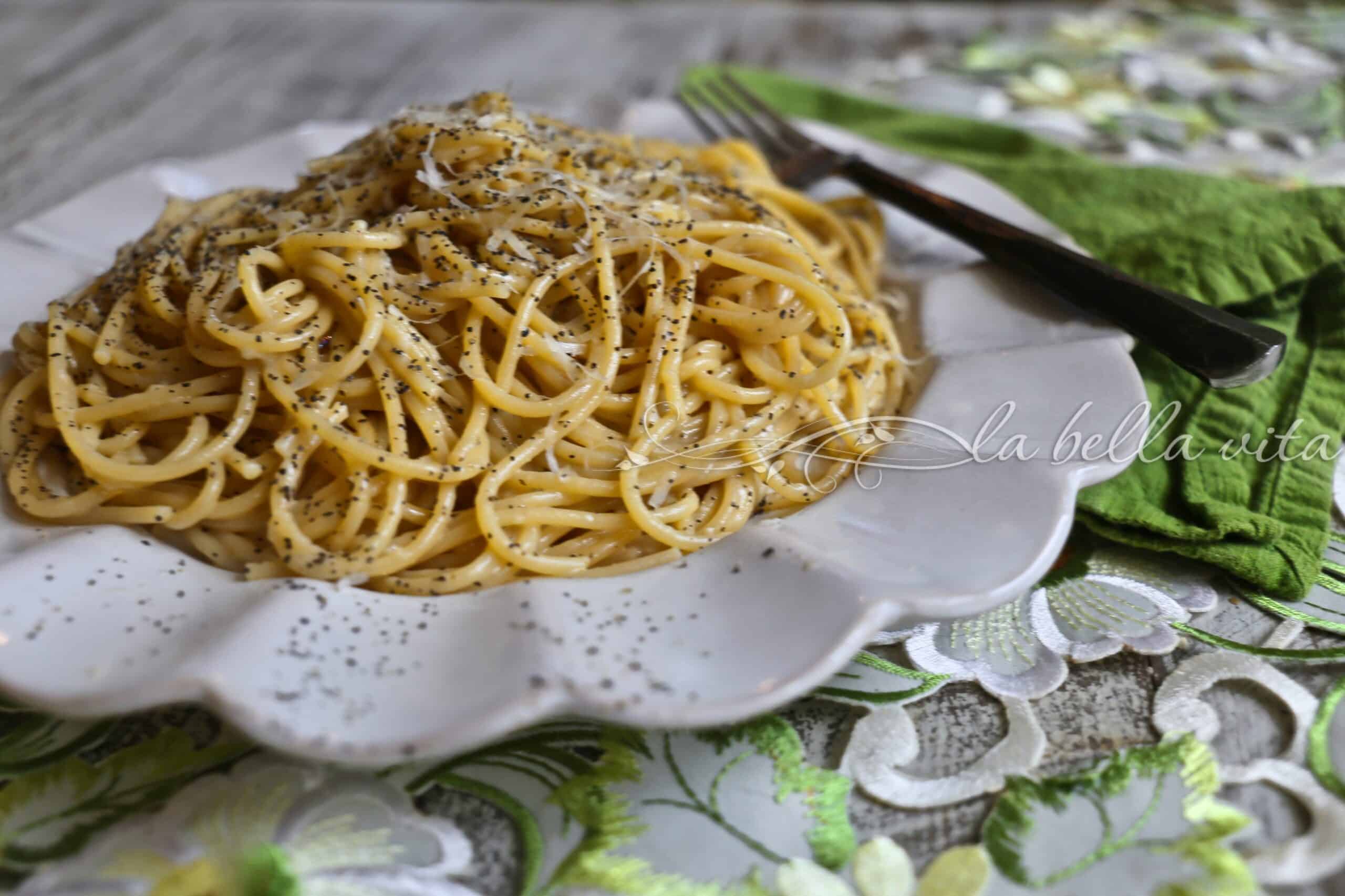
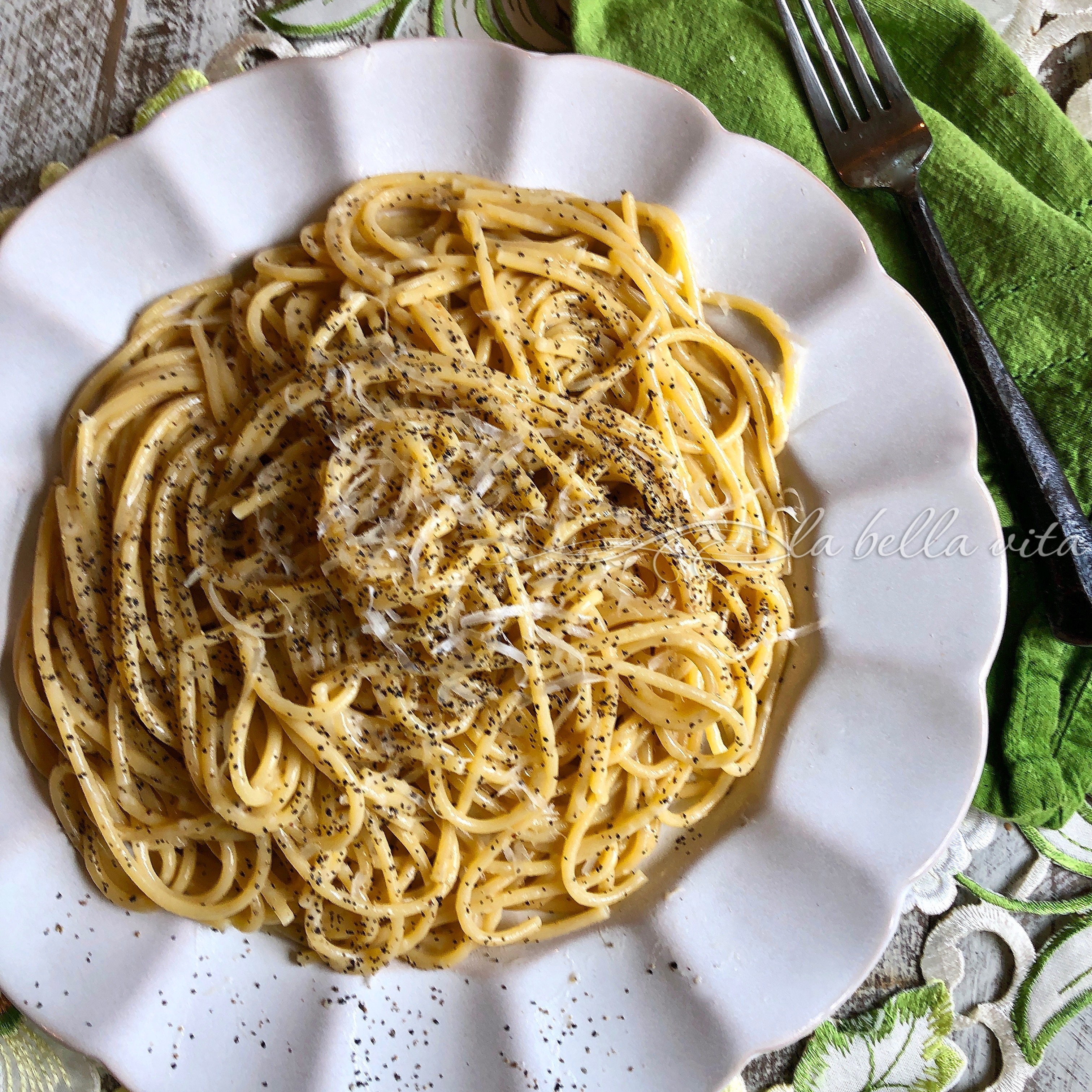
Cacio e Pepe is perfectly delicious in its incredible simplicity: Pasta, Pecorino Romano cheese, and freshly cracked black pepper . . . period. The name literally means ‘cheese and pepper”.
Just a few high-quality ingredients and technique . . . that’s what Cacio e Pepe is all about! When preparing the dish, you use some of the hot water from the pasta pot that the pasta was cooking in. The sauce ‘creams’ by the starch in the hot water working like a gentle glue that ultimately thickens up the recipe. The cheese also melts from the hot pasta. So it’s not really a sauce, but rather it’s a creamy, silky smooth cheese coating on the pasta noodles. Add in the strong, earthy essence of freshly cracked black pepper, and a delicious contrast in flavors results. If possible, crack some fresh black peppercorns in a pepper grinder or a coffee bean grinder. You’ll love the fresh aroma added to the dish that’s almost intoxicating!
Remember to only use really high-quality IMPORTED Italian spaghetti if you can. I know that is sometimes not available in your local food markets, but trust me, it’s worth ordering online if you need to. The texture can’t be beat plus quality pasta releases more starch that contributes to the creamy cheese ‘sauce’. The best pasta State-side that is closest to Italian quality spaghetti is literally Barilla’s ‘Collezzione’ spaghetti that is hard to find in most markets but can be found on Amazon. Our local Publix carries it, but before that, I had to buy it online. I won’t buy any other spaghetti now unless it’s imported from Italy or the Barilla Collezzione pasta. By the way, the original Barilla pasta company is from my home region in Italy and is there to this day. And even more interesting, is that Barilla selected my hometown of Ames, Iowa in the U.S.A. for one of its pasta production facilities!
How crazy is that?
Whenever we travel, we do our culinary homework to determine where to find the best of any traditional recipe, the best gelato, the best street food, and local fresh markets. And that goes for ANY country too, not just in Italy. These places aren’t always a ‘big name’ well-known restaurant found on Trip Advisor that some may think of. In fact, we love to ask the locals for their favorite places to eat because they usually know the best-kept secrets. You know that you’re in a local favorite when you’re the only people in the place that speak English and everyone is staring at you. We had never heard of this place before but found out that Roma Sparita makes one of the most memorable Cacio e Pepe in all of Rome!
Well, I must tell you that, as promised, Roma Sparita delivered the smoothest, silkiest, creamiest, cheesiest version of Cacio e Pepe that I’ve ever tasted!
Because of that nirvana pasta experience, I just had to re-create the recipe. To my surprise, I discovered that the authentic recipe was slightly adjusted . . . the secret ingredient of a tad bit of butter is added. BUTTER! The non-traditional use of butter creates a sauce that is even more creamy than the original recipe. Puritans will frown on this, but one of the best recipes is served at a Roman eatery where a bit o’ butter is added. Just giving a heads up for all of all of those recipe purists.
Ever since childhood, my family has always prepared what we called ‘white’ spaghetti . . . the only ingredients being pasta, butter, salt, and pepper. This is in contrast to our regular ‘red’ spaghetti tossed in a Bolognese tomato-meat sauce. Pasta in butter is absolutely brilliant in taste and always served alongside the red-sauced pasta in my family. I always gobble up the buttered spaghetti first!
So it’s no wonder to me that I have fallen in love with this special version of Cacio e Pepe
Here’s a map of where the restaurant is with Vatican City and Villa Borghese as reference points to the north. Roma Sparita is in the south of Rome in the neighborhood of Trastevere.
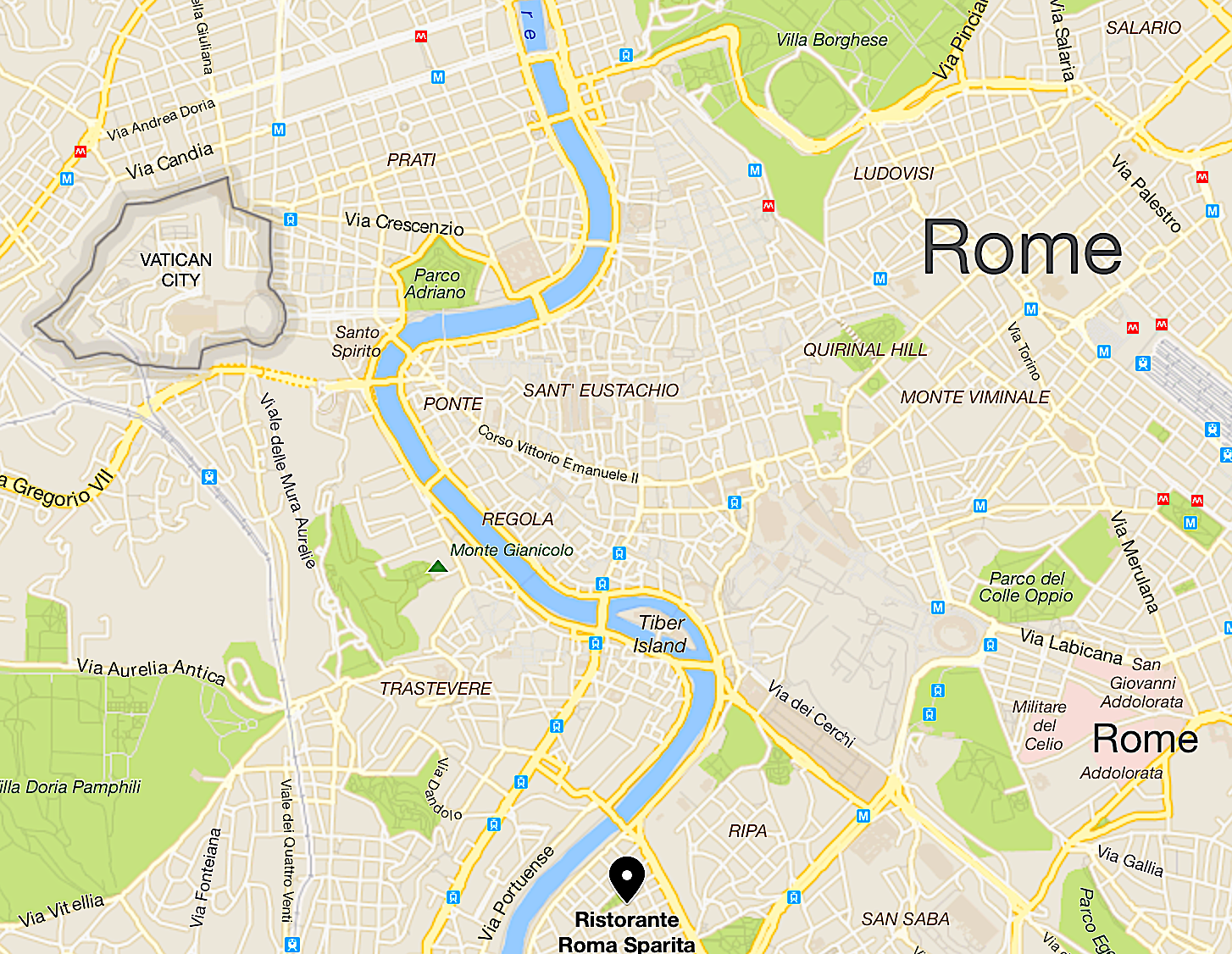
So when you visit Rome, check out this small Italian restaurant and enjoy their famous Cacio e Pepe!
What is Cacio e Pepe?
Quite literally, Cacio e Pepe means “Cheese and Pepper” in Italian. (It’s pronounced “kah-chee-oh eh peh-peh”). It’s actually quite fun to say!
Considered today as Italy’s original ‘macaroni and cheese’, it is indescribably far better and insanely delicious!
For centuries, this famous cheesy pasta dish has been a staple in Roman cuisine. It is traditionally made with a thicker spaghetti pasta noodle, Pecorino cheese – the ‘cacio’ (no, not Parmesan), and lots of freshly-cracked black pepper – the ‘pepe’. Ladles of the hot, starchy water used to boil the pasta are added. This is the ‘thickener’ combined with the melted cheese that makes the amazing creamy base. It’s insane! No cream is required (but I wouldn’t hold that against you even if you added some)! Then, as mentioned above, you simply add in several heaping tablespoons of butter to make this creamy sauce out-of-this-world heavenly!
Andiamo a Cucina!
(Let’s go to the kitchen!)
Before we get started, let’s gather up the ingredients you’ll need for this recipe:
INGREDIENTS
- Pasta: Traditionally, only long noodles are used for this dish, especially thick spaghetti — do not use thin spaghetti or angel hair spaghetti, this dish requires a stronger, heftier pasta.
- Pecorino Romano Cheese: Classic Cacio e Pepe is prepared with high-quality, aged, and imported Pecorino Romano cheese that is grated fresh, at the moment of preparation – this is essential . . . nothing from a bag or a green can. If you only have Parmigiano Reggiano (Parmesan) cheese, that’s fine, but just know that’s not the cheese used in classic Cacio e Pepe). My husband is really great at grating fresh cheese and I really enjoy cooking together in the kitchen with him. Here’s our preferred grater if you need a good one!
- Freshly-cracked black pepper: In all of our recipes, we prefer to use a freshly-cracked, coarse grind of black pepper for Cacio e Pepe. You’ll need a great pepper grinder to do the job!
- Butter: This is optional, but after years of making Cacio e Pepe, I’m convinced that adding butter to the ‘sauce’ just takes this dish to pasta blissfulness! If possible, use room-temperature butter and not cold butter.
How To Make Cacio e Pepe
- Crush and toast black peppercorns. Traditionally, a stronger black pepper flavor is achieved by sautéing/toasting crushed peppercorns in either water or butter for a few minutes, which is the first step in the classic recipe.
- Cook the pasta. Fill a large stockpot 2/3 full with salted water (sea salt is best), boil your pasta until barely al dente. You want a nice firm ‘bite’ to your pasta and you never, ever want to cook pasta as long as a package states because pasta keeps cooking and will ultimately be a platter of mush if overcooked.
- Prepare the sauce. Grate the cheese while the pasta water heats up and comes to a boil. Add hot water to the grated cheese to form a pourable mixture. Set aside.
- Drain the pasta, but KEEP the pasta water! Set it aside to use in the creamy sauce! Use a good colander to drain the pasta if you don’t have a pasta pot with a colander.
- Add the ‘al dente’ pasta to crushed pepper.
- Add pasta water and cheese ‘sauce’ to the pasta mixture. Add a few ladles of the reserved starchy pasta water and toss everything quickly to combine.
- Serve immediately! Cacio e Pepe is best served the very second it is removed from the stove.
- Garnish with additional grated pecorino cheese and freshly-cracked black pepper.
Creative Additions for Cacio e Pepe
We love to change recipes up a little bit now and then, so here are a few delicious recommendations:
- Add small bits of prosciutto or guanciale for some delicious protein.
- Add fresh zucchini blossoms.
- Add green peas.
- Add chopped asparagus.
- Add chopped green or red peppers.
- Add crushed red pepper flakes for a nice kick of heat.
- Add minced garlic.
Products that I use and highly recommend
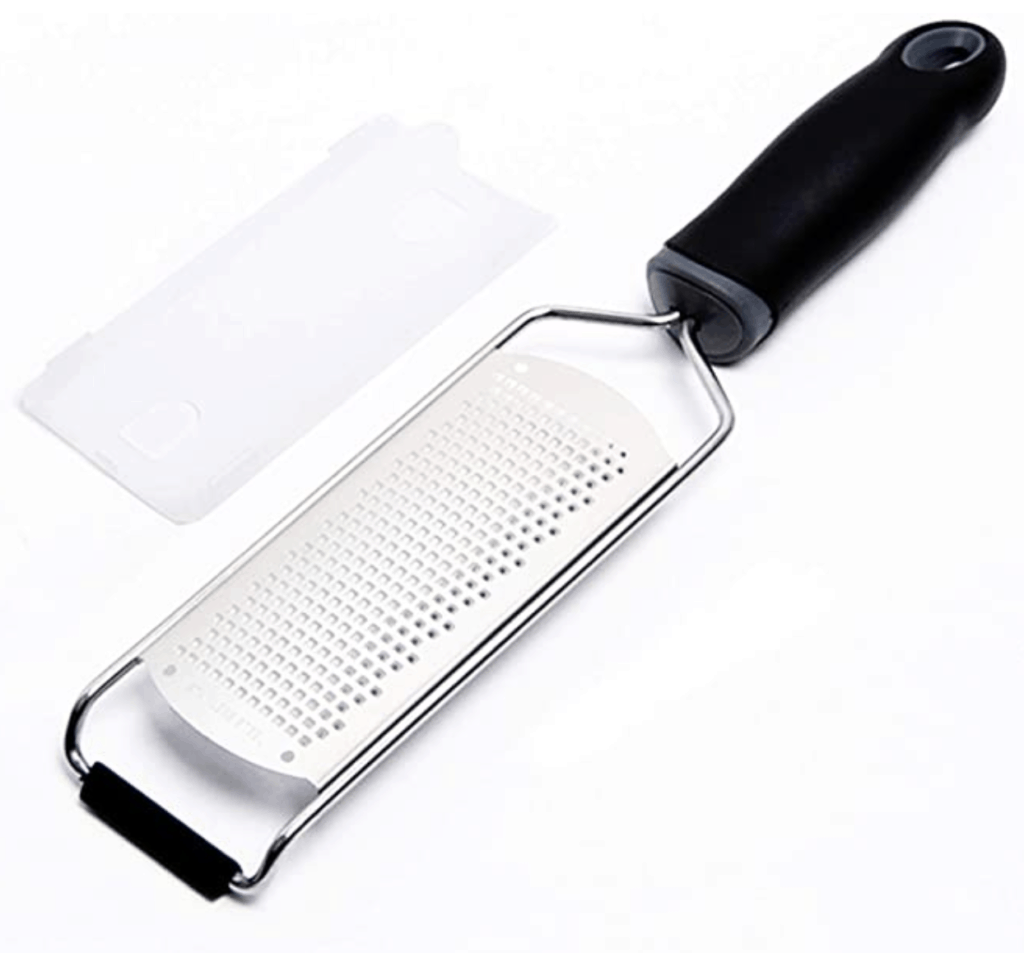
Hand-held cheese grater with protective cover
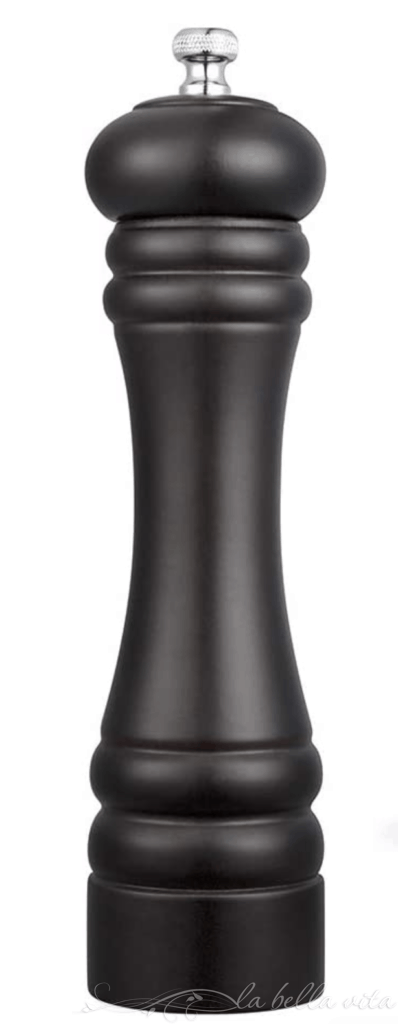
Wooden Pepper Grinder with Adjustable Coarseness
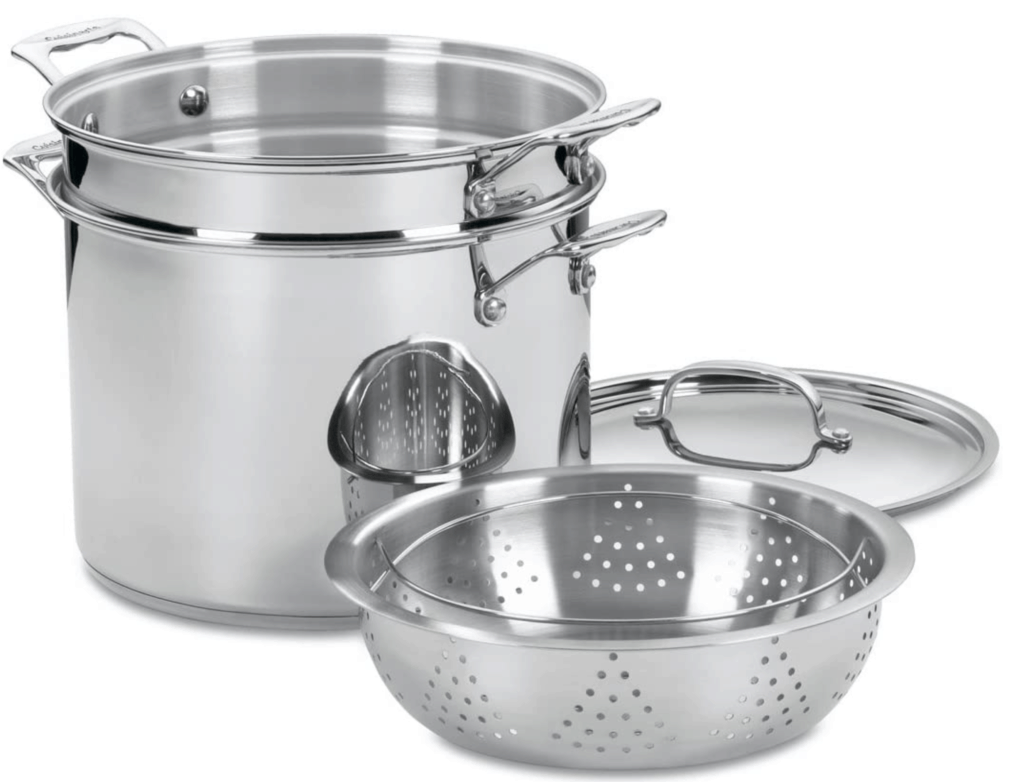
4 Piece Pasta Pot with 2 Strainers
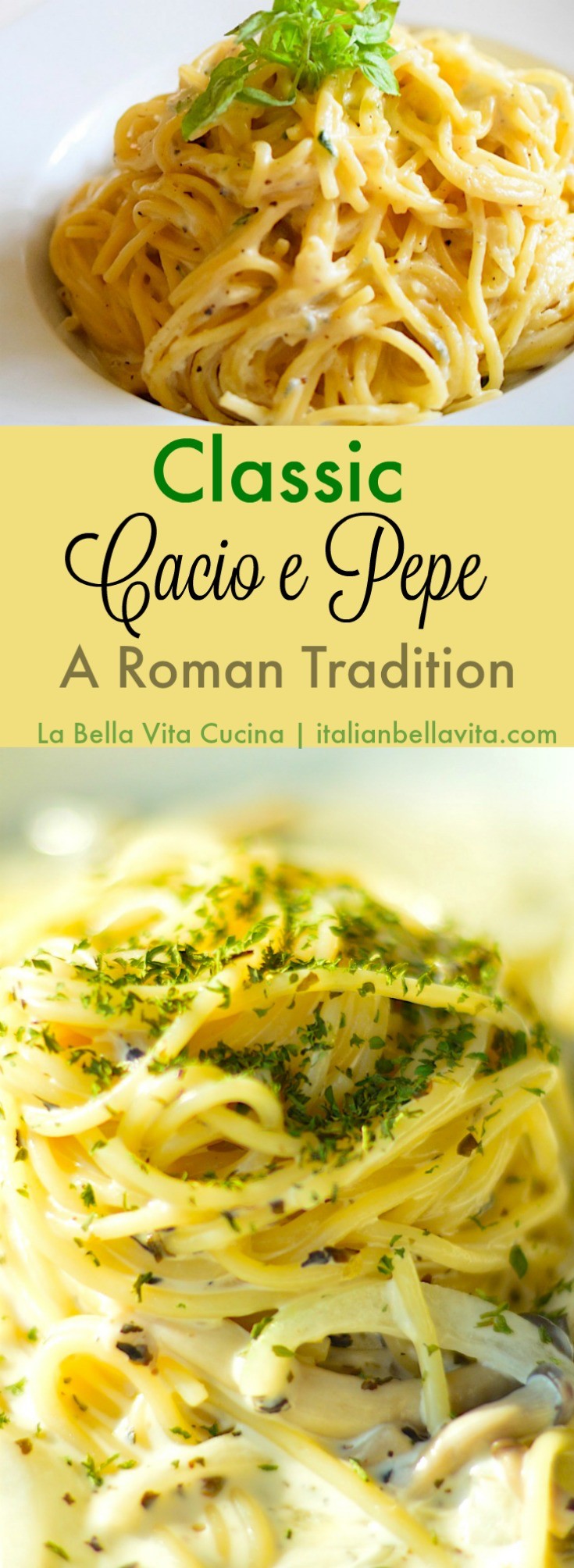
Pin for later!
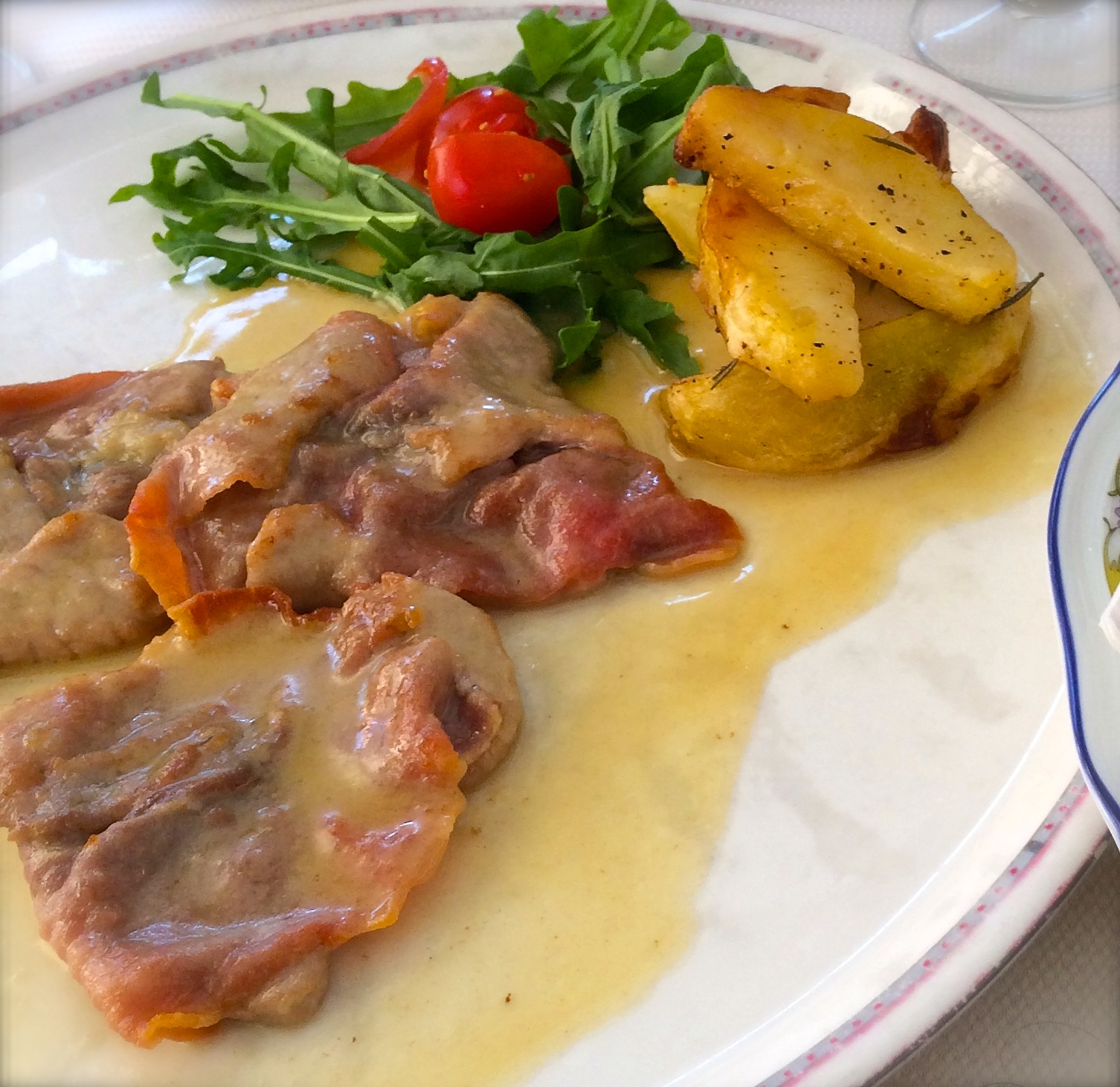
More Traditional Roman Dishes To Enjoy

Cacio e Pepe
Ingredients
- 12 oz. tonnarelli pasta or regular, thick spaghetti (not thin)
- tall pot of water, boiled
- 2 Tbsp. salt for pasta water
- 4 Tbsp. black peppercorns
- 2 Tbsp. butter
- 8 oz. fresh Pecorino Romano cheese, cut into ½” pieces
- OR ½ cup fresh Parmigiano Regiano plus ¼ cup Pecorina Romano if you prefer a ‘less sharp, less salty cheese flavor
Instructions
- In a large, wide frying pan, toast/saute’ the black peppercorns in either the butter or some pasta water, until fragrant, about 3 – 4 minutes.
- When cooled, remove the peppercorns and place them in either a spice grinder or crush them until coarse (not finely ground) in a mortar and pestle. Put 1-½ teaspoons of the coarse black pepper into a large mixing bowl. Also, set aside a small bit of black pepper to use as a garnish upon serving.
- In a food process, process the Pecorino Romano cheese for 2 minutes until finely ground.
- With the cheese still in the food processor, keep the processor on (running) and SLOWLY add ¼ cup of hot water and process until the cheese reaches a consistency of yogurt/sour cream. If it is not pourable, then add another ¼ cup of hot water, 2 teaspoons at a time, while the processor is still on (running). Scrape down the sides of the processor bowl and continue processing for 1 more minute, until the mixture is smooth.
- In a tall pot, bring 2 quarts of water to a boil. Add 1 – 2 tablespoons of salt to the water. Add the pasta and cook until ‘al dente’ (firm, but not hard when you bite into it), about 6-7 minutes, rather than the amount of time indicated on the package instructions.
- When the pasta is almost cooked al dente, scoop out 1-½ cups of the pasta water and set it aside.
- Add 2 Tablespoons of this hot pasta water to the crushed black pepper in a large mixing bowl.
- When the pasta is finished cooking al dente, use tongs to quickly transfer the pasta to the bowl with pepper. Do not discard any leftover past water at this point (you may need it).
- To this, now add 1/4 cup of your reserved pasta water and half of the Pecorino Romano cheese ‘paste’.
- Vigorously toss all of this together with the tongs, stirring for 2 minutes.
- Add the remaining cheese ‘paste’ and continue to toss and stir until all of the cheese paste is melted and the pasta is coated with a glossy, lightly thick sauce, for 2 more minutes. If needed, add more hot pasta water, stir, and toss again for another minute. If the pasta is cooling while you do this, set the bowl over the pot of pasta water to gently rewarm the sauce with the residual heat of the water, stirring again for no longer than 30 – 40 seconds. For simplicity, pour everything in the pan that you just used to toast the black peppercorns and turn the stove heat to a very low setting to reheat the pasta.
- If the ‘sauce’ begins to clump or gets too dry, add a little more of the pasta water as you are stirring.
- Serve immediately in warmed bowls, garnished with the reserved grated cheese and freshly cracked black peppers.
- Minced fresh Italian parsley and /or a sprig of fresh Italian parsley is a very pretty garnish too!
Buon Appetito!
Note: This post may contain affiliate links; view My Disclosure Policy for details. I earn a small percentage from any purchase you make by clicking on these links at no extra cost to you.
This recipe was originally posted in 2019 and updated with more information and updated photos in 2025.


Couldn’t agree more about using Italian dried pasta…worth searching out. You probably won’t be surprised to know I bring home brands I’d never see here. We have a house brand that we like a lot.
Oh Phyllis, please let me know the names of the pasta brands that you have brought back from Italy!!!!
Thanks,
Roz
xoxo
I can’t use any other pasta than imported Italian pasta now. I watched something about the difference in production of Italian pasta that makes it so different (and so much better). Very interesting!
I wonder what time of the day Anthony was at the Fontana…there’s nobody there! Re the Cacio, the version I’ve been making for a number of years does include butter…works like a charm. The “pasta police” might get a little miffed at the list of “variations,” however I would consider the addition of those fabulous zucchini blossoms. I had that at one of favourite little places…great food, not traditional…their cooking riffs on traditional…excellent food. Locally sources products…never been disappointed! There are always opinions on where the best Cacio or the best Carbonara is to be found in Roma and it’s a lot of fun doing the research!
I totally agree, Phyllis, aout the ‘pasta police’, but then there are many Italian chefs who are experimenting with new, contemporary versions of classic Italian recipes . . . not trying to say that any new recipe is bettert than the older, traditional recipes, but rather to respect tradition while at the same time, moving forward (slowly, due to the critics and customer demand). I’m glad that my family is not the only one that enjoys ‘butter’ in a creamy sauce! I’d love to know the brands of pasta that you purchased and love!
Ciao, Roz
I’m really inspired with all of the delicious and beautiful recipes that you post, Roz.
A great Pasta dish Cacio e Pepe, I must try this at home.
Thank you, I hope that you enjoy it!
Cheers!
To be in Rome is to Eat!
Hi Don,
I totally and completely agree! I wish I could return again SOON!
Ciao,
Roz
You described it beautifully and now I have to try it! Looks absolutely delicious ! I’m going to look for some Italian pasta, even if I have to order it!
I’m sure you’ll enjoy the pasta from Italy, Jan!
This sounds delicious, Roz! We drove to the outskirts of Rome and turned around 3 times, long story, still want to go there though, and esp. for dishes like this. Yum! Thanks for the recipe.
I would love to be in Rome right now, turning around no matter how many times to return to some of the best food on the planet. I hope to return next year and savor this dish again and get the ‘real deal’ in the right original location. Thanks for stopping by Pam, it’s nice to hear from you!
Ciao,
Roz
I really miss pasta!! Haven’t had them since I have been trying to have a lower carbs diet..and whenever I want some real carbs, I tend to eat some bread:-) Sighs…this looks so good, Roz.
Like you Angie, I’m a carb lover. I can’t live without pasta so I could never do well on a low carb diet. You have more strength and discipline that I do, that’s for sure!
Ciao,
Roz
This dish definitely looks intoxicating! I’ve been making my own pasta lately so I’m so excited to give this dish a try. Thank so much for sharing!
Oh I would love this class dish with some of your fresh pasta, MJ! What a treat! Let me know when I can fly in? 🙂