
Pesto alla Trapanese ~ A Sicilian Classic
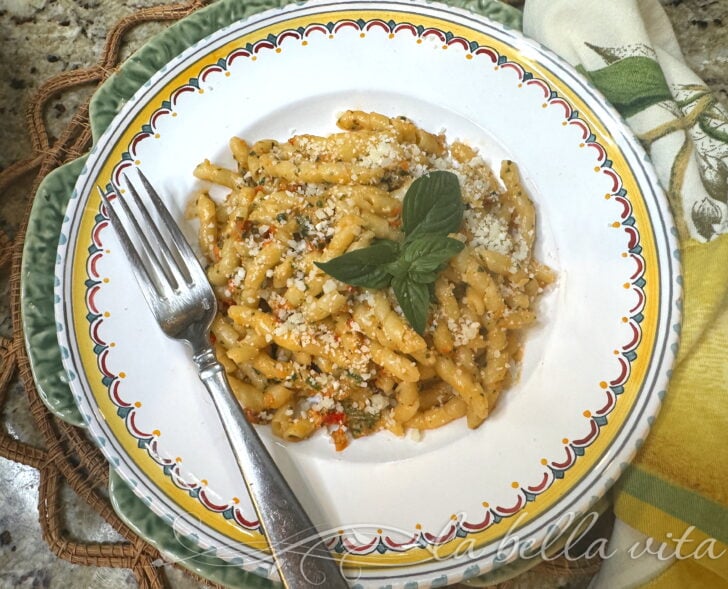
Pesto alla Trapanese is the classic basil, tomato, and almond-based pesto from Sicily that differs from the northern Genovese basil pesto made with pine nuts and no tomatoes at all. And that’s about the only difference between the two pestos.
Both pestos require no cooking at all . . . all of the ingredients are blended together in either a traditional mortar and pestle or in a food processor. Both can be served as either an antipasto with slices of Italian bread or with warm pasta as a main entree.
Both pestos are simple, fresh, and absolutely delicious . . . proving that Italian recipes with the simplest ingredients can create the most incredibly flavored dishes.
Fresh, ripe tomatoes, fragrant basil, almonds, garlic, extra-virgin olive oil, and Italian cheese come together in this rustic Sicilian pesto.
What Is Pesto alla Trapanese vs. Pesto Genovese?
Pesto alla Trapanese — also known locally as ‘agghiata Trapanisa‘ — comes from Sicily’s western coast, and the Mediterranean port of Trapani and its surrounding area. This pesto developed when Italian sailors from Genoa arrived in the port and introduced their (northern) Genovese pesto (that we are most familiar with) to the locals. The story behind this pesto is a wonderful example of how Italian regional cooking evolved through travel, trade, and the locally available ingredients.
The people of Trapani loved the recipe and adapted it with ingredients that grew in the area: Instead of pine nuts, they used almonds. And with Sicily’s abundance of sun-ripened tomatoes, they added tomatoes to the mixture as well (when tomatoes weren’t a major crop in the North).
The result was a somewhat different, yet delicious pesto — juicy from the tomatoes, slightly nutty from the almonds, still fragrant with basil, and rich with Sicilian extra-virgin olive oil.
The ingredients changed to create a pesto that is unmistakably Sicilian.
When most of us hear the word pesto, we immediately think of the famous bright-green Pesto alla Genovese from Liguria. But pesto actually refers to the method of preparing the sauce. The word comes from the Italian verb “pestare“, meaning ‘to pound or crush‘ because traditionally, pesto ingredients were crushed together in a mortar with a pestle.
Both are wonderful, but they are wonderfully different!
The Secret Is Using Excellent Ingredients
Because there is virtually no cooking involved in Pesto alla Trapanese, the quality of every ingredient matters. This is definitely not the recipe for pale, flavorless winter tomatoes!
Use the ripest, sweetest tomatoes you can find, preferably during summer when tomatoes are at their peak. Fresh fragrant basil, good-quality almonds, fresh garlic, excellent extra-virgin olive oil, freshly grated cheese, sea salt, and freshly ground black pepper complete the pesto.
If you have access to a beautiful Sicilian extra-virgin olive oil, this is certainly the time to use it. With so few ingredients in the recipe, you’ll taste the quality of each one.
Almonds Make This Pesto Special
One of the defining ingredients in authentic Pesto alla Trapanese is almonds. Sicily is famous for its almonds, and they give this pesto a completely different personality from traditional Ligurian pesto made with pine nuts.
The almonds add body and a gentle nuttiness without overwhelming the fresh tomatoes and basil. Traditionally, peeled almonds are used, but if you don’t have these, you can blanch whole almonds and slip off their skins. This is far too much work for me, so you can just do as I do and buy toasted almonds to make things easier. And this is a good thing!
One little tip: don’t pulverize those beautiful almonds into almond butter! A little texture is part of this sauce’s rustic character.
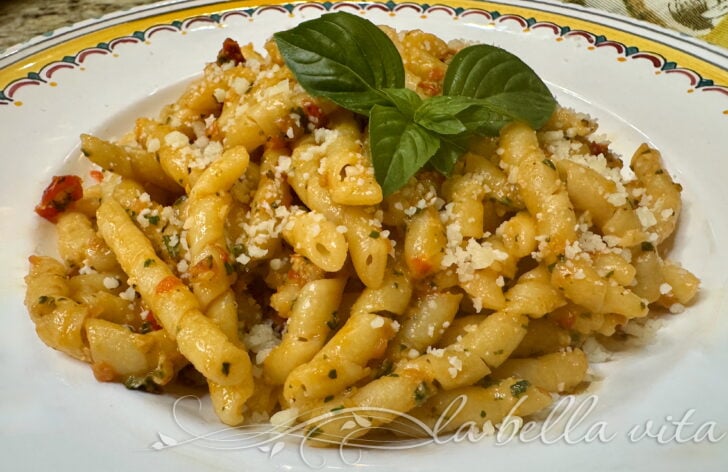
Use a Mortar and Pestle or Food Processor?
Traditionally, all pestos (both Genovese and Trapanese pestos) are prepared with a mortar and pestle in which garlic, basil, and nuts are mashed until they form a rustic base, to which grated cheese and olive are added. Today, if you have the time and enjoy preparing food the old-fashioned way, making it like this is a wonderful culinary experience.
A food processor makes this recipe incredibly easy, and if you have weak arms as I do, it takes much less time. Just remember not to over-process the pesto when using a food processor. PULSE . . . PULSE . . . PULSE the ingredients rather than running the processor continuously to retain a rough texture. You don’t want a perfectly smooth pesto sauce — rustic is good!
Don’t Cook the Pesto!
An important thing to remember about Pesto alla Trapanese is that it is a RAW sauce. The heat of the hot cooked pasta that you immediately add to the pesto is what warms up the final dish.
A Little Pasta Water Makes All the Difference
It’s also crucial to remember to save some of that precious hot pasta water before you drain the pasta. As I do with all my pasta recipes, add a few splashes, sometimes even a ¼ cupful of pasta water, to the dish to beautifully coat the pasta and create a silkier pasta sauce texture. Even a small splash will completely transform the consistency of the finished pasta dish.
WHY? The starch in the pasta water helps the pesto and olive oil come together and cling to the pasta rather than the sauce collecting at the bottom of your serving bowl. Add just a little at a time until the pesto is luscious and silky.
Can Pesto alla Trapanese Be Made Ahead?
Absolutely! In fact, preparing the pesto a little before serving gives the flavors time to mingle.
Prepare the pesto, transfer it to a covered container, and refrigerate it until you’re ready to cook your pasta. I like to take it out of the refrigerator and let it come closer to room temperature before tossing it with the freshly cooked pasta. ** Drizzle a thin layer of olive oil on top, then lay plastic cling wrap directly on top to prevent the basil from turning brown.**
So when your garden is overflowing with basil, and those gorgeous summer tomatoes are finally ripe, grab a handful of almonds and make Pesto alla Trapanese.
Andiamo a Cucina! (Let’s get to the kitchen!)
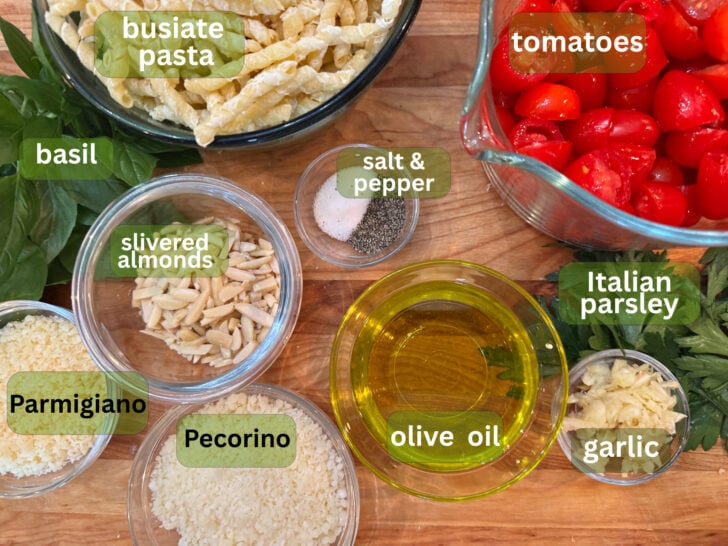
Ingredients for Pesto alla Trapanese
One of the beauties of Pesto alla Trapanese is its simplicity. With just a handful of fresh ingredients, quality really matters here, especially when it comes to the tomatoes, basil, cheeses, and extra-virgin olive oil.
- Tomatoes — Always use ripe, garden-fresh cherry tomatoes or larger slicing tomatoes — both work beautifully. Choose the ripest, sweetest tomatoes you can find.
- Toasted Almonds — Almonds are one of the ingredients that distinguish this Sicilian pesto from traditional Pesto Genovese, which is made with pine nuts. Lightly toasting them brings out even more of their wonderful nutty flavor.
- Garlic — A crucial ingredient; again, use the freshest (and not jarred) garlic available.
- Basil — You need a LOT of Fresh basil (large leaves) only to give this pesto its unmistakable fragrance and beautiful Italian flavor.
- Pecorino Romano — Pecorino, an Italian sheep cheese, adds a sharper, saltier flavor that pairs especially well with the sweetness of the tomatoes and almonds. Pecorino Toscano (from Tuscany) is milder than Pecorino Romano (from Rome). However, it’s harder to find and thus more expensive.
- Parmigiano Reggiano — If you prefer a slightly milder cheese flavor, then do what I do, and add a bit of Parmigiano to the mix to balance the sharper Pecorino Romano. It also adds another layer of rich, nutty flavor.
- Extra-virgin olive oil — Use the best-quality extra-virgin olive oil that you have. A wonderful Sicilian olive oil would be especially appropriate here!
- Lemon juice (optional) — Just a touch to brighten all of the flavors . . . use only freshly-squeezed lemon juice.
- Roasted red pepper flakes (optional) — Add these if you enjoy a little bit of heat.
- Busiate pasta — The traditional Sicilian pasta partner for Pesto alla Trapanese! It may be difficult to find in stores, but it’s easy to find online (link). However, another pasta shape, such as penne, will work fine.
How to Make Pesto alla Trapanese
You can easily learn how to make this dish by following along with my video showing you how to prepare it!
Pesto alla Trapanese is wonderfully easy to prepare, and best of all, the pesto itself requires no cooking. You can prepare it traditionally with a large mortar and pestle or use a food processor for a quicker method. Either way, try to retain some texture rather than processing the pesto until completely smooth.
- Grind/mash the toasted almonds and garlic. — either in a traditional mortar and pestle or a food processor. One little tip: don’t pulverize the almonds into almond butter! A little texture is part of the rustic character of this sauce.
- Add the fresh Italian parsley and basil — and continue to pulse them in the food processor or crush with a mortar and pestle until blended with the almonds and garlic.
- Add the cheeses — pulse or grind until incorporated throughout the pesto.
- Slowly drizzle in the olive oil — a little at a time, continuing to pulse or grind as you go.
- Add the tomatoes — continue to mash or grind them into the pesto. Keep some texture in the tomatoes rather than making it completely smooth.
- Add the optional seasonings — if you like, add freshly squeezed lemon juice for a little brightness and roasted red pepper flakes for a touch of heat. Give everything one final gentle mix, then set the pesto aside while you prepare the pasta.
- Bring the pasta water to a rolling boil — adding a generous 1 – 2 Tablespoons of salt to the water.
- Cook the busiate — for approximately 2 minutes less than the package instructions. Before draining the pasta, reserve at least 1 cup of the starchy pasta cooking water.
- Ladle some pesto onto a serving platter. — to make it easier to distribute the sauce gently into the pasta.
- Add the pasta and fold into the pesto — Using a large serving spoon, gently fold the pesto through the fragile busiate pasta.
- Add some reserved pasta water — to create a silkier pasta sauce.
What Is Traditionally Served With Pesto alla Trapanese?
If you want to enjoy this dish as you might in western Sicily, look for busiate pasta, a unique shape not found in many grocery stores. This traditional Sicilian pasta has a distinctive long, twisted spiral shape. All of those wonderful little curves are perfect for catching the pesto.
If you can’t find busiate pasta, don’t let that stop you from making this wonderful dish. Casarecce and fusilli are especially good pasta shape alternatives, although penne, rigatoni, and paccheri (my personal favorite) are also great with this pesto.
What to Serve With Pesto alla Trapanese
This pesto, when tossed with pasta, is already substantial and needs little else alongside it. Serve it with a simple green salad, some grilled/roasted chicken or fish, and some crusty Italian bread.
You really don’t need anything complicated.
Here are some of my favorite dishes to serve with Pesto alla Trapanese:
- A simple, crisp green salad — Toss fresh greens with tomatoes, cucumber, red onion, and a light red wine vinaigrette or simple dressing . . . the pesto packs a hefty punch of flavor, enough when served in a whole meal.
- Roasted or grilled chicken — A wonderful protein to serve alongside the pasta.
- Grilled fish — A simply prepared mild white fish is lovely with the fresh tomato and basil flavors in the pesto.
- Crusty Italian bread
When serving the pesto without pasta and by itself as an antipasto, serve with:
- Italian bread/crostini – Slices of thin baguette bread, toasted/roasted to spread with the pesto.
- Vegetable crudites – Sticks of carrots, celery, or whatever you prefer to dip into the pesto.
Don’t Forget Dessert!
If you’re serving this during summer, after such a fresh Mediterranean meal, finish dinner with fresh peaches, melon, or a simple lemon or watermelon dessert. Nothing complicated – – keep things simple and follow it up with a light and simple dessert. Fresh peaches, melon, or berries are perfect during the warmer months, or serve a refreshing lemon granita for a wonderfully Sicilian finish. Here are some great ideas for you:
- Lemon Granita
- Watermelon Granita
- Grilled Peaches with Crumbled Amaretti and Balsamic Glaze
- Peaches with Prosciutto and Balsamic Glaze
Another Delicious Way to Serve Pesto alla Trapanese
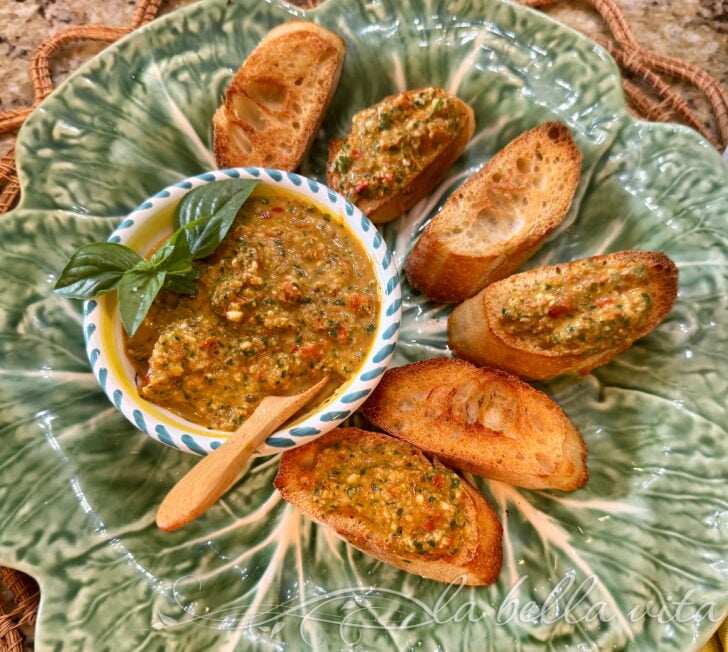
Here’s another delicious way to enjoy Pesto alla Trapanese that doesn’t involve pasta at all!
Serve this beautiful Sicilian pesto as an antipasto, spooned into a little serving bowl surrounded by crisp, warm, toasted baguette slices.
The fresh tomatoes and basil give the pesto a wonderful brightness, while the almonds, cheese, and olive oil make it rich enough to spread generously onto toasted bread. It’s like a delicious Sicilian cousin to bruschetta!
To prepare the bread, cut an Italian (or French) baguette into thin rounds on a slight diagonal. Lightly brush the slices with extra-virgin olive oil and toast them in the oven until golden and crispy around the edges, but still have a little tenderness in the center.
Ladle the pesto into a small serving bowl. Garnish it with a few fresh basil leaves, and if you like, sprinkle a little freshly grated Pecorino Romano over it before serving.
Place the bowl on a platter and arrange the toasted baguette slices around it. Let everyone spoon the pesto onto their own toasted bread and enjoy it before dinner.
This is an especially lovely way to serve Pesto alla Trapanese for a summer gathering, as an Italian antipasto platter, or whenever friends stop by and you want to serve something delicious without a lot of fuss.
And if you have a little pesto left over after making pasta, this is a wonderful way for everyone to enjoy every last spoonful.
Two completely different dishes from one beautiful Sicilian pesto — now that’s something to love!
How to Store Pesto alla Trapanese
If you have leftover Pesto alla Trapanese, transfer it to an airtight container and refrigerate it promptly. I like to smooth the top of the pesto and drizzle a thin layer of extra-virgin olive oil over the surface before covering it. This helps protect the fresh basil and keeps the pesto from being exposed to too much air.
For the freshest flavor and best texture, I recommend enjoying homemade Pesto alla Trapanese within 3 days. Because this is a fresh, uncooked pesto made with tomatoes, basil, garlic, and cheese, always keep it refrigerated rather than leaving it at room temperature for extended periods.
Can You Freeze Pesto alla Trapanese?
Yes! If you’ve made more pesto than you can enjoy within a few days, freezing is a wonderful option. Spoon the pesto into small freezer-safe containers so you can thaw what you need instead of defrosting the entire batch.
For the best quality, use the frozen pesto within about 2–3 months. Thaw overnight in the refrigerator, give it a good stir, and add a small drizzle of fresh extra-virgin olive oil if the consistency needs loosening.
How to Store Leftover Pasta with Pesto
If the Pesto alla Trapanese has already been tossed with the busiate, transfer the leftover pasta to an airtight container and refrigerate it. I recommend enjoying the pasta within 2 – 3 days for the best flavor and texture.
When you’re ready to enjoy it again, remember that this pesto was never intended to be heavily cooked. Let the pesto lose some of its refrigerator chill before serving and warm it up slowly. A small drizzle of extra-virgin olive oil can help loosen the pesto and bring back some of that lovely silky texture.
And don’t be surprised if the pesto darkens slightly while refrigerated. Fresh basil naturally changes color when exposed to air, but a little olive oil stirred into the pesto before serving will help freshen it up.
More Recipes For You To Enjoy
If you love the fresh tomatoes, basil, and garlic flavors in Pesto alla Trapanese, here are a few more recipes that I think you’ll enjoy!
- Fresh Basil Pesto
- Cherry Tomato Basil Pesto Sauce on Farfalle Pasta
- Tagliarini Picchi Pacchiu (Linguine Toscana) — A great (copycat) recipe (one of my most popular) features fresh tomatoes and lots of garlic. Picchi Pacchiu is a Sicilian tomato-based sauce.
- Spaghetti with Toasted Garlic Breadcrumbs
- Easy Fresh Tomato Pasta Salad with Cheese and Herbs
- Sun-Dried Tomato Pesto, Basil Pesto, and Turkey Bagels
Buon appetito! 🇮🇹

Sicilian Pesto alla Trapanese
Ingredients
- 1 lb. fresh, ripe tomatoes, cherry or slicers
- ¾ cup toasted almonds
- 3 – 4 garlic cloves, minced
- 3 Tbsp. fresh Italian parsely, minced
- 3 cups fresh basil leaves (or about 40 large leaves), minced
- ½ cup Pecorino Romano cheese, freshly grated
- ¼ cup Parmigiano Reggiano cheese, freshly grated
- ¾ cup extra-virgin olive oil
- ¼ tsp. freshly-squeezed lemon juice, (optional)
- 1/4 tsp. roasted red pepper flakes, (optional)
- 1 lb. Busiate (shaped) pasta, or any pasta shape works fine
Instructions
- In either a food processor, or using a large mortar and pestle, grind the almonds and the garlic together.
- Add the Italian parsley and basil leaves and continue to mash or grind.
- Add the cheese and contiune to smash or grind.
- Add the olive oil a little at a time (to drizzle) and continue to smash or grind.
- (optional) add lemon juice
- (optional) add red pepper flakes
- Set aside the pesto and bring a large, tall pot of water to a rolling boil. Generously salt the water (1 – 2 Tbsp.)
- When water is boiling, add the busiate pasta and boil/cook for 2 minutes less than the package instructions.
- Place a cup or so of the sauce on the bottom of a large, wide platter.
- Add the cooked pasta. Take a large serving spoon and gentlly fold the pesto into the pasta. This shape is fragile, so go slow.
- Add some pasta water, about ¼ cup at a time to make the pasta a little more silky in appearance and consistency. You shouldn't have to use more than 1 cup of pasta water for this step.
- If desired, add more pesto sauce.
- Serve and garnish with sprigs of fresh basil.
- BUON APPETITO!ROZ
Notes


Fresh homemade pesto are the best! I still love mine with pine nuts though :-))